Casimira
Meaning of Casimira
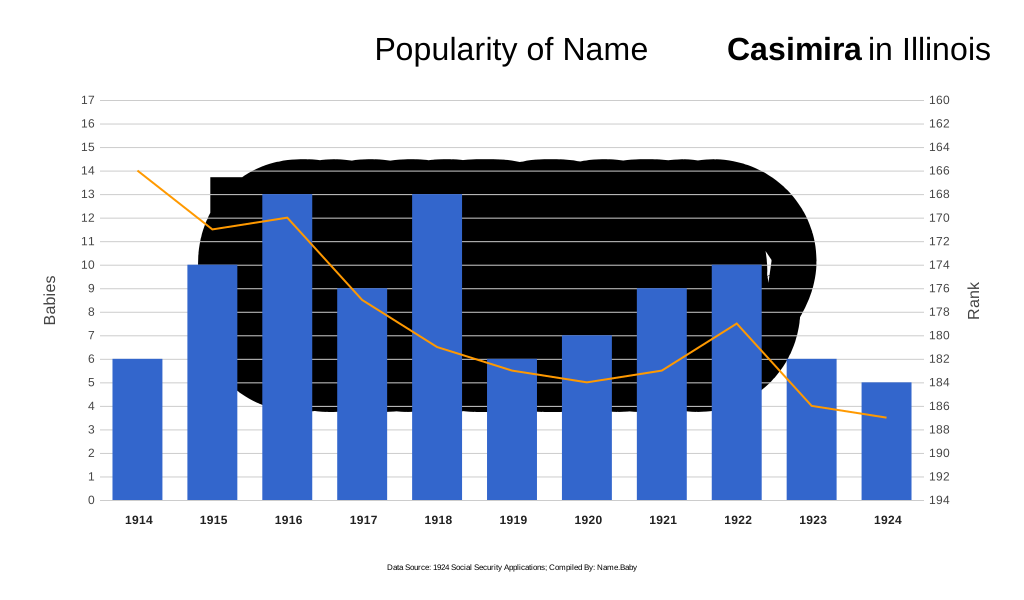
Casimira, the graceful feminine counterpart to the venerable Slavic appellation Kazimir, derives from the Old Church Slavonic kázati (“to proclaim”) and mír (“peace”), thereby embodying a “proclaimer of peace” whose syllables resonate with the measured dignity of medieval courts. In the lexicons of Latin-inspired tongues, it is rendered with harmonious consistency—pronounced kah-see-MEE-rah, with the subtle sibilant shift from Spanish [kaˈsi.mi.ra] to Italian [kaˈzi.mi.ra]—unfurling in speech like a banner of serene authority. Epidemiological data from early twentieth-century Illinois births reveal Casimira’s modest yet persistent presence: between 1914 and 1924, five to thirteen newborns bore the name annually, ranking quietly within the state’s anthroponymic tapestry. While never a ubiquitous choice, its rarity confers an air of cultivated exclusivity, much like a fresco hidden in a cloister’s alcove, visible only to the discerning observer. The name’s academic pedigree and saintly associations—a nod to medieval Central European princes and their patronage—imbue it with a latent gravitas that appeals to parents seeking a moniker both erudite and poetically resonant. Though unassuming, Casimira possesses an almost paradoxical tension: as gentle as a whispered benediction yet as architecturally sound as a Roman aqueduct, it bridges the personal and the universal, inviting each bearer into a lineage of dignified peace-makers. It hardly threatens to overshadow a first-grader’s modest lunchbox.
Pronunciation
Spanish
- Pronunced as kah-see-MEE-rah (/kaˈsi.mi.ra/)
Italian
- Pronunced as kah-see-MEE-rah (/kaˈzi.mi.ra/)
U.S. Popularity Chart
Notable People Named Casimira
| Casimira Rodríguez - |
