Catharina
Meaning of Catharina
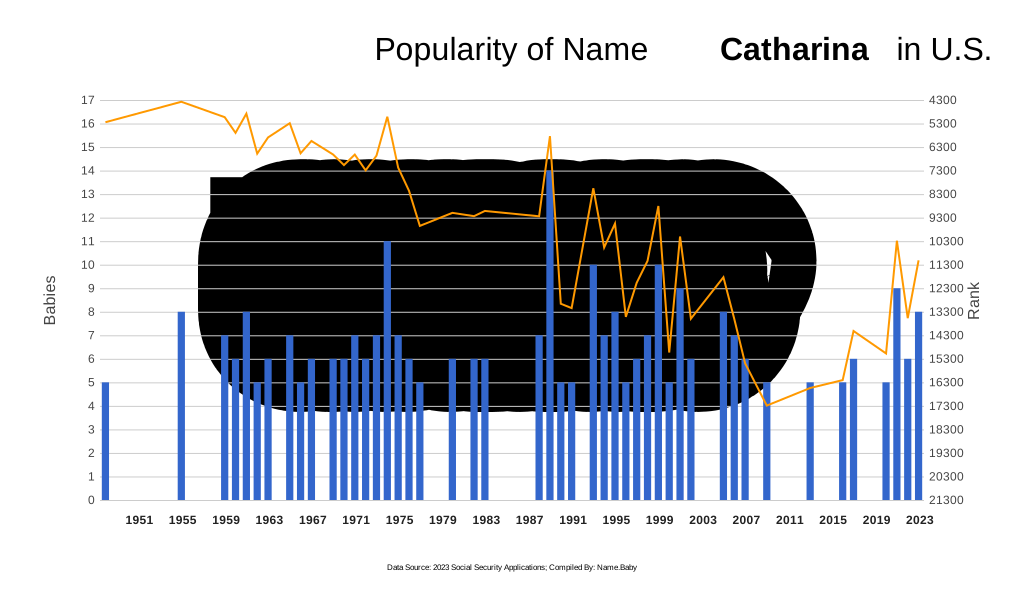
Derived from the ancient Greek Αἰκατερίνη (Aikaterine) and Latinized as Catharina, this variant of Catherine originates from the root katharos, meaning “pure,” and has been borne by European royalty and sanctified by St. Catherine of Alexandria, whose enduring legacy in medieval theology and art deepened its association with intellectual rigor and spiritual fortitude. Embraced primarily in Germanic and Dutch-speaking regions—where it is pronounced kah-tah-REE-nah in both languages—as well as in Scandinavian and Iberian contexts, Catharina’s pan-European resonance transcends linguistic borders; in the United States, its historical usage, modest yet steady—ranging from a peak rank of 683 in 1948 to 945 in 2024—underscores its enduring appeal among parents who value classical heritage coupled with accessible elegance. Functioning as an analytical symbol of continuity, the name serves as a connective thread woven through cultural narratives of purity, piety, and perseverance, imparting to modern bearers a nuanced blend of historical gravitas and timeless refinement.
Pronunciation
Dutch
- Pronunced as kah-tah-REE-nah (/ka.ta.ˈri.na/)
German
- Pronunced as kah-tah-REE-nah (/ka.ta.ˈʁi.na/)
U.S. Popularity Chart
Notable People Named Catharina
| Catharina van Hemessen - |
| Catharina Elisabeth Goethe - |
| Catharina Baart Biddle - |
| Catharina Treu - |
| Catharina van Rennes - |
| Catharina Regina von Greiffenberg - |
| Catharina van Rees - |
| Catharina von Schlegel - |
| Catharina Cornelia Hodshon - |
| Catharina Peeters - |
