Charles
Meaning of Charles
Charles comes from the Germanic name Karl, meaning free man — a man who was not a serf or a bondsman. It entered English through the French form Charles, and its Latinized form Carolus was long used in royal and scholarly circles. The usual short forms are Charlie and Chuck.
It is pronounced CHARLZ, with the same pronunciation in British and American English.
The name carries strong royal associations in Europe, largely thanks to Charlemagne, or Charles the Great, and it has been borne by British monarchs down to King Charles III. Among its best-known modern bearers are the novelist Charles Dickens and the naturalist Charles Darwin.
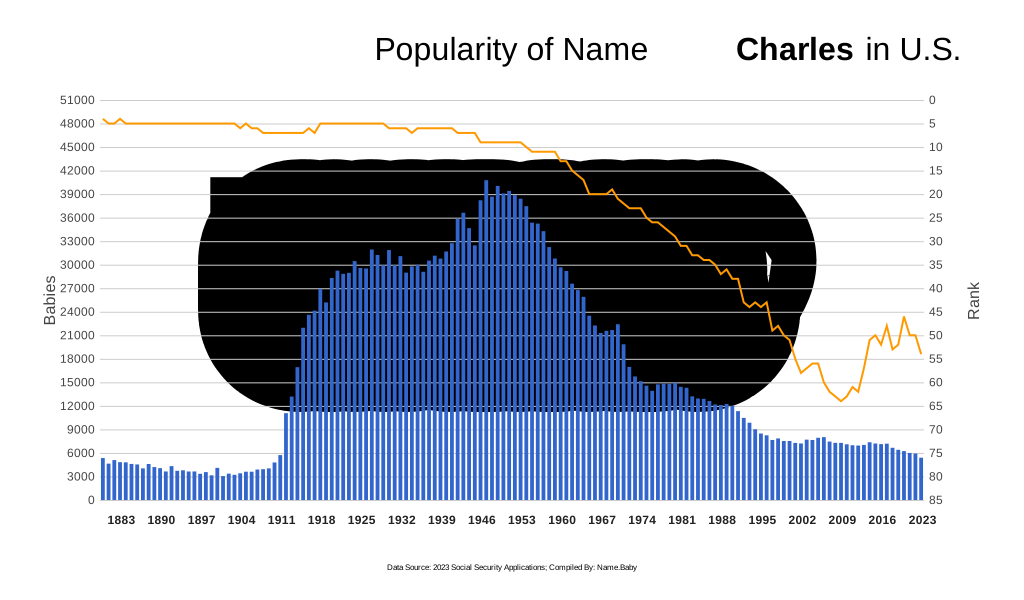
In the United States the name has never fallen far from use. It ranked 4th in 1880 and stayed in the top ten for much of the next century; 1947 holds its largest yearly count, with 40,781 babies and a rank of 9th. Use has eased since then but has not collapsed: it slipped to 64th in 2009 and stood at 48th in 2025, when 5,898 boys received the name. Parents today tend to choose it for its solid, traditional feel, and many of them use Charlie in everyday life.
Pronunciation
British English
- Pronunced as CHARLZ (/tʃɑːlz/)
American English
- Pronunced as CHARLZ (/tʃɑrlz/)
U.S. Popularity Chart
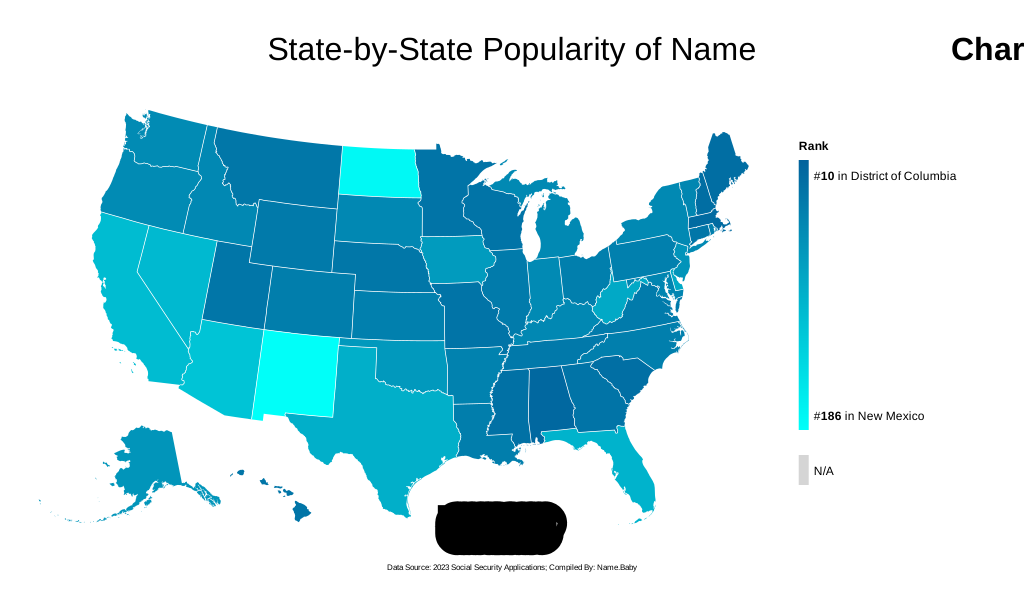
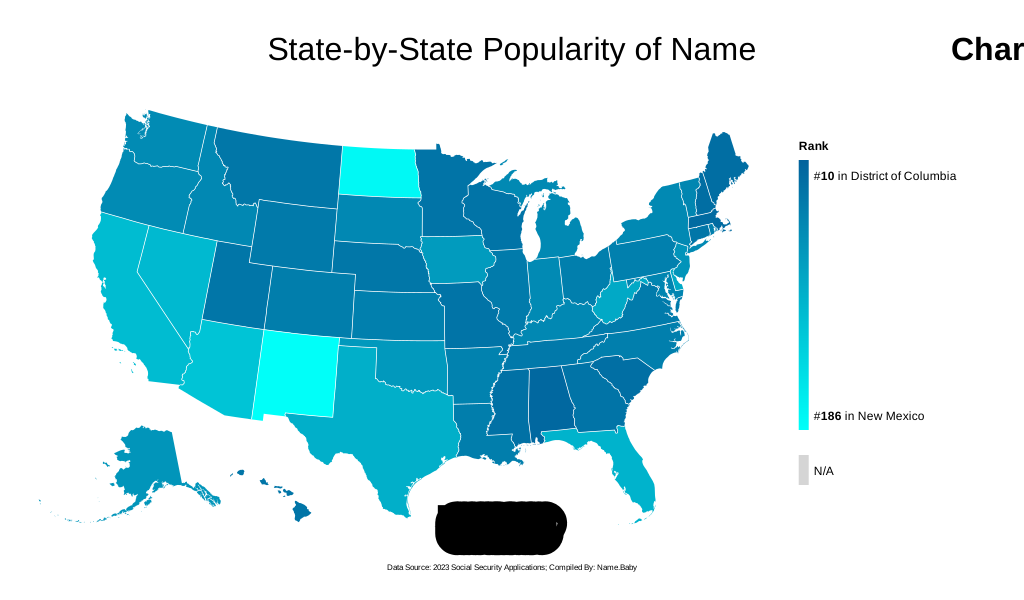
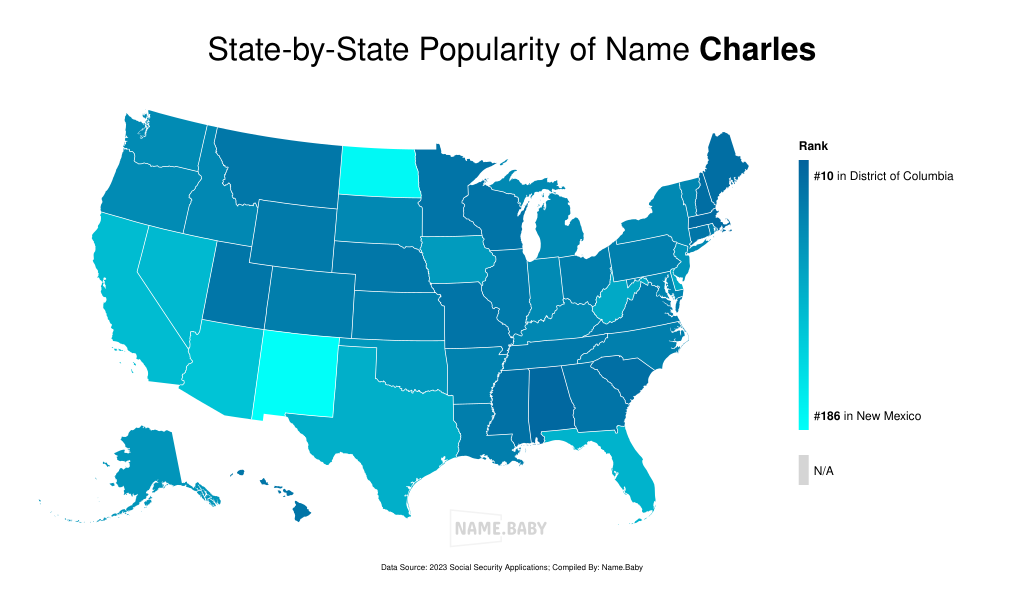
States Popularity Chart
Notable People Named Charles
| Charles Lindbergh was an American aviator who in 1927 made the first solo nonstop flight from New York to Paris in the Spirit of St. Louis, earning worldwide fame and advancing modern air travel. |
| Charles de Gaulle was a French general and statesman who led the Free French in World War II, restored democracy as head of the provisional government from 1944 to 1946, returned in 1958 to draft a new constitution and found the Fifth Republic, and served as president until his 1969 resignation. |
| Charles Dickens was an English novelist and social critic whose beloved Victorian stories and characters made him a literary giant still read today. |
| Charles Darwin was an English naturalist who proposed that species evolve from common ancestors through natural selection, reshaping biology and becoming one of the most influential figures in history. |
| Charles Barkley is an American former NBA star and TNT and CBS analyst who played 16 seasons, was an 11-time All-Star and 1993 MVP, and made the NBA 50th and 75th anniversary teams. |
| Charles Babbage was an English polymath, mathematician, philosopher, inventor, and mechanical engineer who originated the concept of a programmable computer. |
| Charles Krauthammer was an American political columnist, known for his Pulitzer Prize-winning columns in The Washington Post and his transition from a liberal to an independent conservative political pundit. |
| Charles Aznavour was a French singer of Armenian descent whose distinctive tenor and 70 plus years crafting over a thousand multilingual songs made him a 20th century pop icon and one of its greatest songwriters. |
| Henry Charles Bukowski was a German American poet, novelist, and short story writer whose Los Angeles influenced work explored the lives of the poor, alcohol, relationships, the drudgery of work, and writing itself. |
| Charles Pierre Baudelaire was a French poet, essayist, translator, and art critic famed for his mastery of rhythm and rhyme, blending Romantic exoticism with keen observations of real life. |
| Sir Charles Lyell was a Scottish geologist whose Principles of Geology advanced uniformitarianism and deep time and strongly influenced Charles Darwin. |
| Charles Ives was an American modernist composer, actuary, and businessman whose once overlooked experimental music later earned acclaim as a defining American voice in 20th century art music. |
| Charles Mingus was an American jazz bassist, composer, and bandleader, widely regarded as one of the greatest for championing collective improvisation over a three decade career that spanned bebop to post bop and featured collaborations with Duke Ellington and Charlie Parker. |
| Charles William Ferdinand, Duke of Brunswick - Charles William Ferdinand, a military leader and the ruling prince of Brunswick-Wolfenbuttel and hereditary duke of Brunswick-Luneburg, is commonly known in English as the Duke of Brunswick. |
