Chet
Meaning of Chet
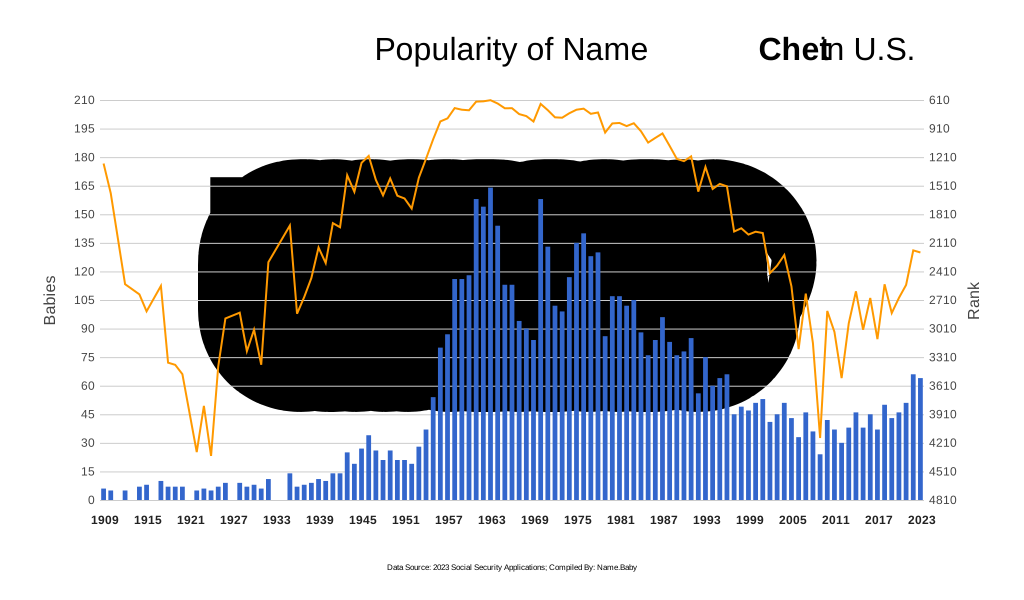
Chet, pronounced chet (/tʃɛt/), enters the Anglo-American name stock as a concise derivative of Chester, the English reflex of Latin castrum, “fortified camp,” and thereby carries a subtle martial-architectural nuance that differentiates it from other monosyllabic masculine options; over time, however, the short form has acquired independent standing, with periodic reinforcement from cultural figures such as jazz trumpeter Chet Baker and country-guitar innovator Chet Atkins, whose mid-century prominence coincided with the name’s statistical zenith in the United States during the 1950s. Although current annual occurrences hover below one hundred, the century-long data set reveals a durable, if modest, presence: a gradual ascent from single-digit listings in the 1910s, a sustained peak between 1940 and 1960, and a steady attenuation thereafter that nevertheless resists complete obsolescence. Within contemporary naming practice, Chet offers parents a phonetically crisp, historically layered choice—rooted in classical Latin, filtered through medieval English to the American frontier—while its brevity aligns with modern preferences for streamlined, easily articulated appellations.
Pronunciation
English
- Pronunced as chet (/tʃɛt/)
U.S. Popularity Chart
Notable People Named Chet
| Chet Baker - |
| Chet Atkins - |
| Chet Faker - |
| Chet Holmgren - |
| Chet Hanks - |
| Chet Huntley - |
| Chet Forte - |
| Chet Walker - |
| Chet Flippo - |
| Chet Curtis - |
| Chet Miller - |
| Chet Morgan - |
| Chet Gladchuk - |
| Chet Phillips - |
| Chet Widerquist - |
