Claud
Meaning of Claud
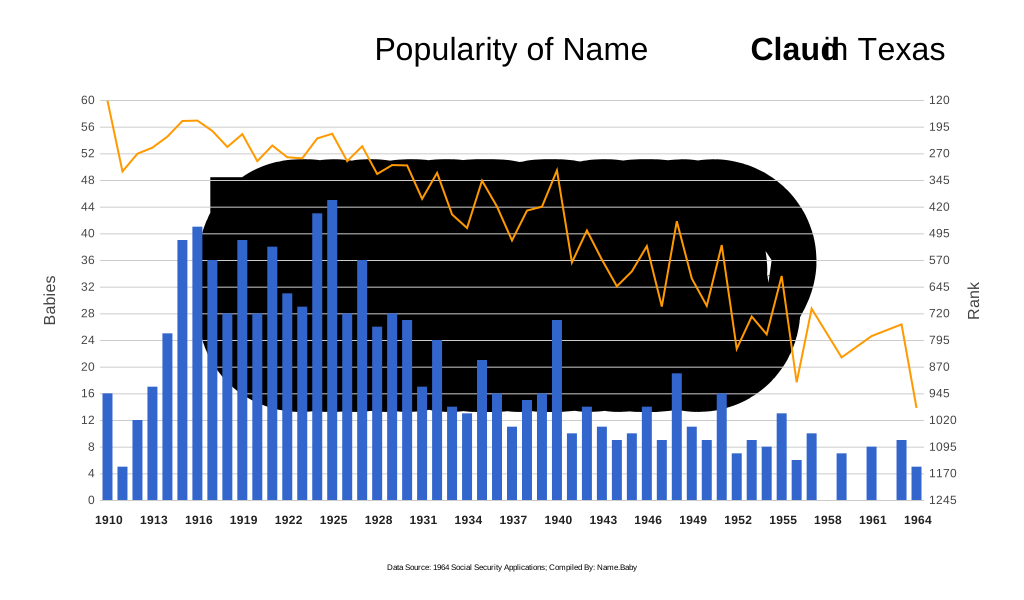
Claud, the streamlined Anglicised form of French Claude, traces its lineage to the Roman cognomen Claudius, a patrician appellation traditionally derived from the Latin claudus, “lame,” whose suggestion of physical frailty paradoxically accompanied one of antiquity’s most politically influential families. In modern usage the name retains a crisp, single-syllable contour: English speakers voice it as /klɔːd/, while French articulation shortens the vowel to /klɔd/, a subtle phonetic divergence that leaves its cultivated timbre intact. Texas birth records illuminate the trajectory of Claud’s popularity in the United States: first surfacing prominently in 1910 with a state rank of 62, the name maintained moderate visibility through the inter-war decades—peaking in the mid-1920s when annual registrations approached forty-five—before receding into single-digit territory by the mid-1960s. Literary and historical references, though comparatively understated, confer additional texture: Sir Walter Scott’s Claud Melville embodies Romantic integrity, and British journalist Claud Cockburn lends the forename an aura of incisive intellect. Consequently, Claud emerges as a choice of measured distinction—rooted in classical heritage, familiar yet uncommon, and well-suited to parents who value brevity tempered by quiet gravitas.
Pronunciation
English
- Pronunced as klawd (/klɔːd/)
French
- Pronunced as klohd (/klɔd/)
U.S. Popularity Chart
Notable People Named Claud
| Claud Cockburn - |
| Claud Butler - |
| Claud Woolley - |
| Claud M. Davis - |
| Claud - |
| Claud Phillimore, 4th Baron Phillimore - |
| Claud Raymond - |
| Claud Barry - |
| Claud Farie - |
| Claud Hancox - |
| Claud Walker - |
| Claud Aspinwall - |
| Claud Cloete - |
