Daphnie
Meaning of Daphnie
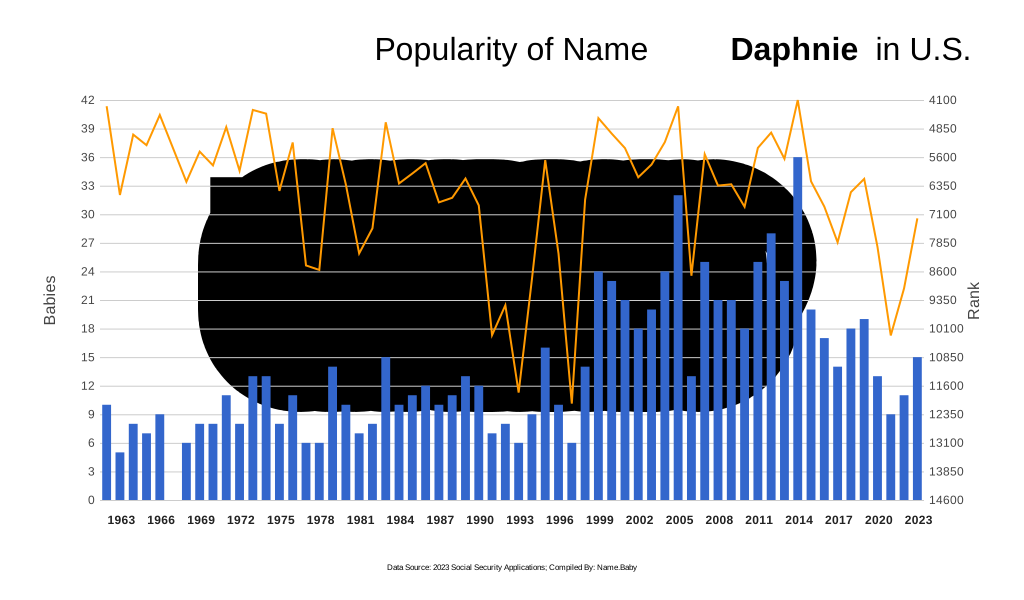
Derived from the ancient Greek Δάφνη (Daphné), signifying “laurel”—a symbol deeply woven into Greco-Roman myth and classical Latin poetry as an emblem of victory and poetic honor—the name Daphnie evokes an analytical tapestry of botanical and mythological resonance. Its trajectory in the United States demonstrates a modest yet stable presence: after cresting near rank 761 in the early 1980s, it has since charted a gradual descent into the lower 900s, with annual occurrences oscillating between nine and twenty births over the past five years and a 2024 placement of 932. Pronounced uniformly in English as /ˈdæfni/—with subtle phonetic shifts to /dafni/ or /daf.nje/ across various European tongues—Daphnie embodies cross-cultural adaptability that mirrors its narrative origin, wherein a nymph metamorphoses into a laurel tree to elude pursuit. This layered lineage confers scholarly appeal for those drawn to names that interweave classical erudition with an understated, enduring allure, much like the laurel’s evergreen presence in Latin verse.
Pronunciation
American English
- Pronunced as DAF-nee (/ˈdæfni/)
British English
- Pronunced as DAF-nee (/ˈdafni/)
French,German
- Pronunced as DAHF-nee (/dafni/)
Italian
- Pronunced as DAHF-nie (/'daf.nje/)
U.S. Popularity Chart