Dekota
Meaning of Dekota
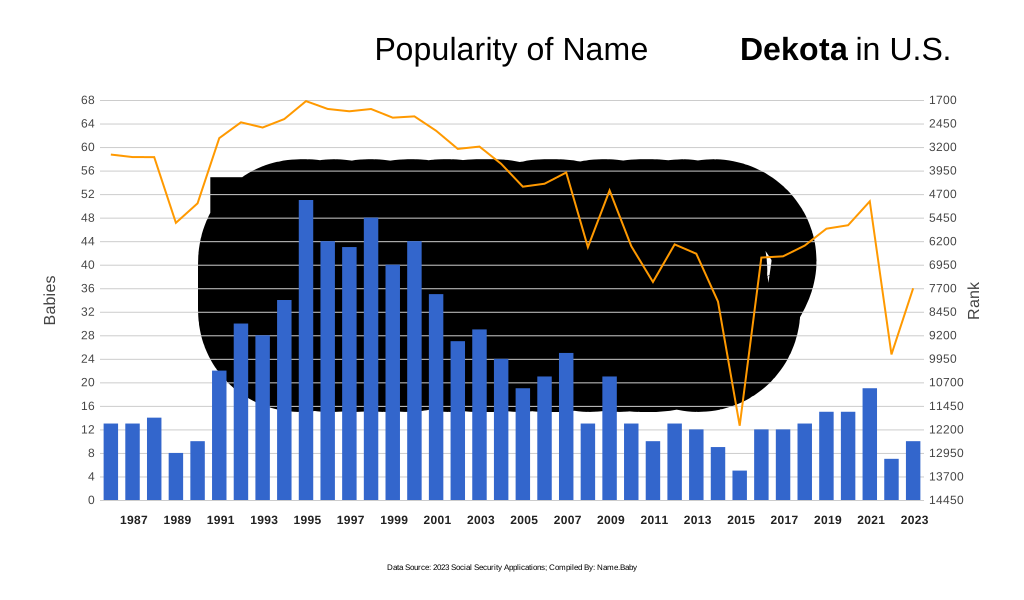
Dekota emerges as a unisex appellation and phonetic adaptation of the Sioux term Dakota—rooted in the Lakota dialect and signifying “friend” or “ally”—that reflects a deliberate orthographic recalibration consonant with contemporary naming trends. From a statistical vantage, its annual occurrence in the United States maintains a discreet yet resilient profile, consistently hovering near the nine-hundredth position in Social Security rankings over recent decades and thereby underscoring its sustained appeal across sociolinguistic strata. Phonetically, Dekota’s trochaic meter and open-ended vowels evoke a sonority akin to classical Latin verse, imparting an almost hymn-like cadence that resonates with notions of unity and camaraderie. Within an analytical framework, the name’s gender-neutral character aligns with modern paradigms of inclusivity, while its semantic core—anchored in indigenous heritage—articulates a cultural fusion that bridges ancestral ethos with contemporary identity. In this sense, Dekota stands as a testament to unitas: a lexical emblem of solidarity that transcends both tradition and innovation.
Pronunciation
British English
- Pronunced as duh-KOH-tuh (/dəˈkəʊtə/)
American English
- Pronunced as duh-KOH-tuh (/dəˈkoʊtə/)
U.S. Popularity Chart