Eleanor
Meaning of Eleanor
Eleanor entered English from the Old French Aliénor, the name of the twelfth-century duchess who became queen of France and then of England. Its deeper origin is uncertain: most name dictionaries connect it to the Greek Helenē, source of the Latin Helena, though the derivation is disputed. The sense usually offered, “light” or “torch,” depends on that link to Helen and is given cautiously, since the etymology is not settled.
In American English the name is pronounced EL-uh-nor; in British English the ending is lighter, EL-uh-nuh.
The best-known bearer from history is Eleanor of Aquitaine, one of the most powerful figures of the medieval West. Eleanor Roosevelt, the longest-serving American First Lady and a delegate to the United Nations, is the most familiar modern namesake. In literature, Jane Austen gave the spelling Elinor to the steady elder sister in Sense and Sensibility.
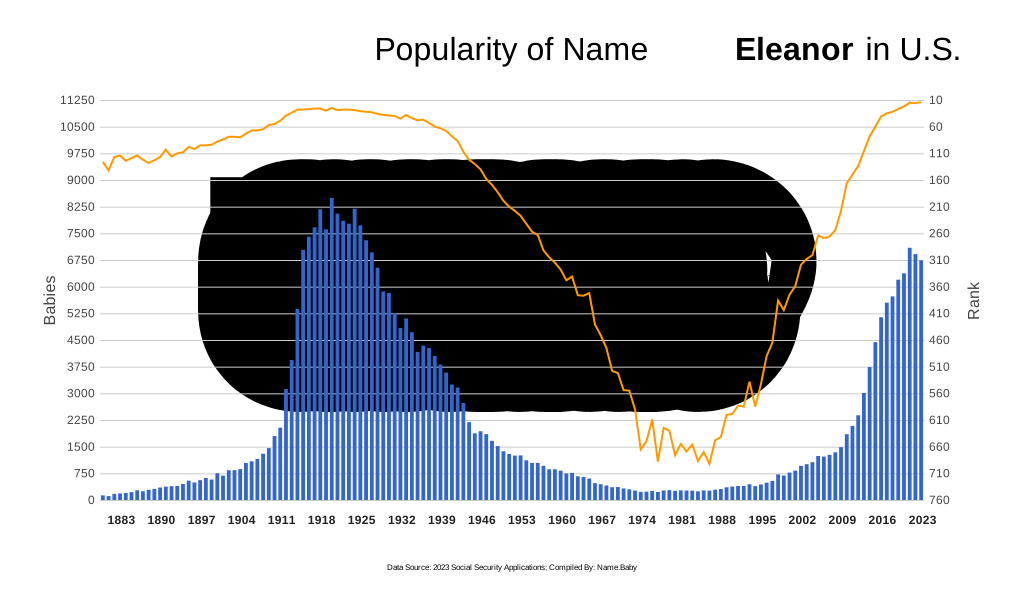
Eleanor has rarely been out of use in the United States, but its standing has moved sharply. In 1986 it fell to rank 692, with 263 girls given the name. It ranked 218 in 2009 and then climbed steadily, reaching 12th place in 2025, its highest position in these records, with 7,649 births.
Pronunciation
American English
- Pronunced as EL-uh-nor (/ˈɛlənɔr/)
British English
- Pronunced as EL-uh-nuh (/ˈɛlənə/)
U.S. Popularity Chart
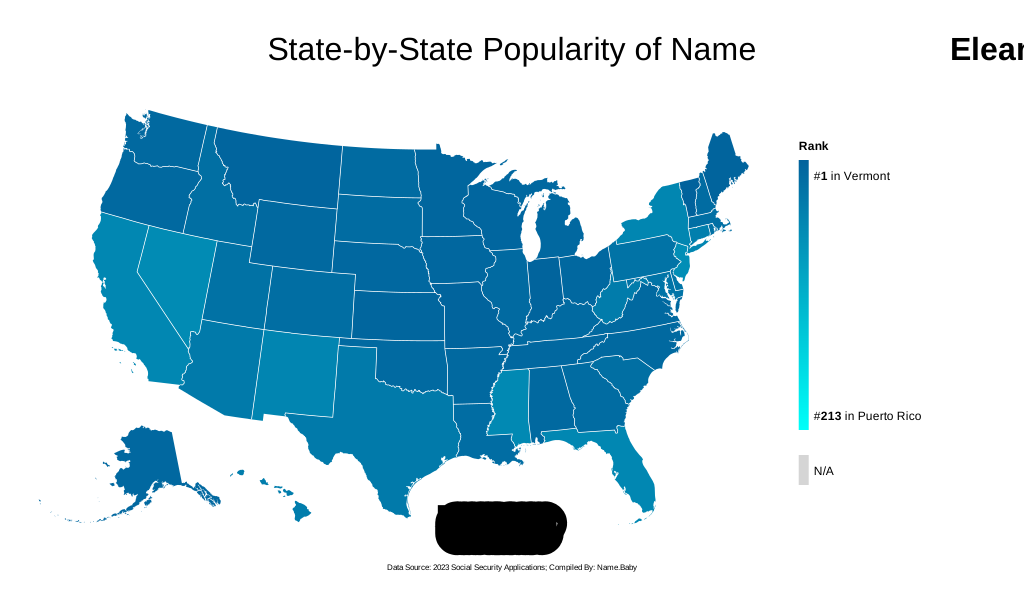
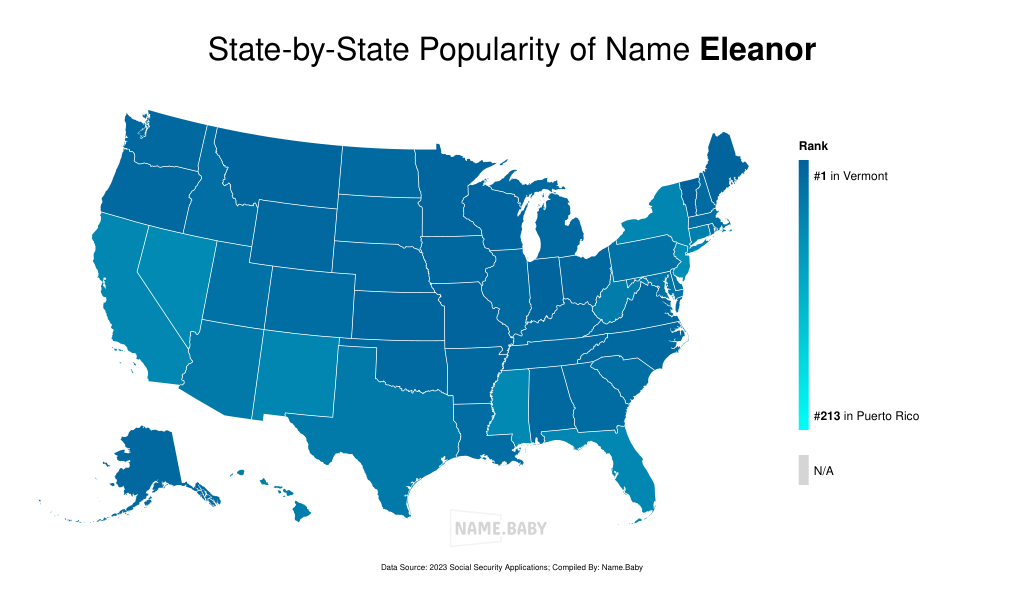
States Popularity Chart
Notable People Named Eleanor
| Anna Eleanor Roosevelt was a pioneering American political leader and activist, the longest serving First Lady, a UN delegate, and a driving force behind the Universal Declaration of Human Rights. |
| Eleanor of Aquitaine was a powerful medieval heiress who became Duchess of Aquitaine and queen of France and England, ruling with Louis VII, Henry II, and her sons Richard I and John. |
| Eleanor of Toledo, a Spanish noblewoman and Duchess of Florence, financed campaigns and the Pitti Palace for Cosimo I de Medici, ruled as regent in his absence, and is often called the first modern first lady. |
| Eleanor of Castile, born in 1307 and died in 1359, was Queen of Aragon as the wife of King Alfonso IV from 1329 to 1336. |
| Eleanor Norcross was an American painter trained by William Merritt Chase and Alfred Stevens who lived mostly in Paris and is best known for Impressionist portraits still lifes and genteel interior scenes. |
| Eleanor Farjeon was an English writer best known for stories and plays for children, along with poetry, biography, history and satire. |
| Eleanor Flexner was an American pioneer of women's studies whose 1959 book Century of Struggle linked the suffrage movement to broader 19th and early 20th century campaigns for education, labor rights, abolition, and temperance. |
| Eleanor Elkins Widener was an American heiress and philanthropist who survived the Titanic and honored her husband and son with major gifts, including the Widener Library at Harvard and the renovation of St. Pauls Episcopal Church. |
| Eleanor Beardsley is an NPR Paris correspondent reporting since 2004 on France and increasingly on major European issues. |
| Eleanor Holm was an American Olympic gold medalist swimmer who competed in 1928 and 1932, was controversially expelled from the 1936 team, and later became a socialite and interior designer who co-starred in Tarzan's Revenge. |
| Eleanor Robson is a British Assyriologist and Professor of Ancient Middle Eastern History at University College London, former chair of the British Institute for the Study of Iraq, Quondam Fellow of All Souls College, and Fellow of the British Academy. |
| Eleanor Clifford, Countess of Cumberland, was the daughter of Charles Brandon, 1st Duke of Suffolk, and Princess Mary Tudor, and the sister or half-sister of Frances Brandon, Anne Brandon, Mary Brandon, Henry Brandon 1st Earl of Lincoln, Henry Brandon 2nd Duke of Suffolk, and Charles Brandon 3rd Duke of Suffolk. |
| Eleanor May Tomlinson is an English actress known for films like Angus, Thongs and Perfect Snogging, Jack the Giant Slayer, Colette and Love Wedding Repeat, and for TV roles in The White Queen, Poldark, The Outlaws and War of the Worlds. |
