Gaston
Meaning of Gaston
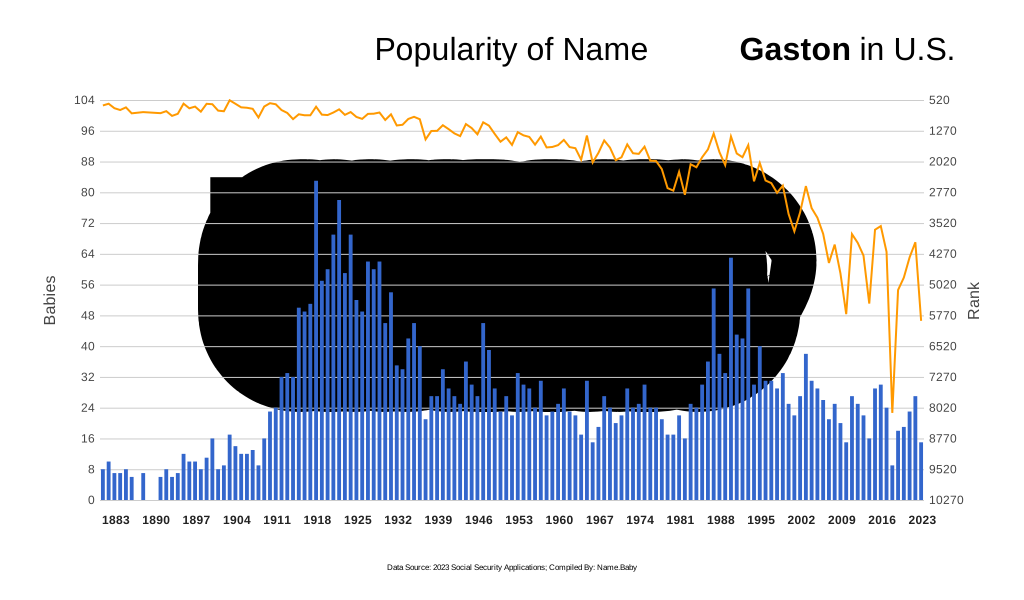
Gaston, a masculine appellation of French provenance derived from the Old Germanic root gast—signifying “guest” or “stranger”—entered the medieval lexicon as a marker of foreignness infused with notions of hospitality, before solidifying into a proper name characterized by a robust consonantal structure and the phonetic profile /ˈɡæs.tən/ in English. Empirical data indicate its specialized status within the contemporary American naming landscape, where it attained a rank of 898th in 2024, reflecting modest but consistent utilization among parents drawn to names with distinctive historical resonance. The name’s cultural footprint extends to the literary sphere through Gaston Leroux, the early 20th-century author of The Phantom of the Opera, and to popular media via the eponymous antagonist of Disney’s Beauty and the Beast, whose imposing persona provides a counterpoint to the etymological associations of welcome and hospitality. Consequently, Gaston embodies a dual heritage—one that merges continental sophistication with narrative depth—positioning it as a technically precise choice for families seeking a name of measured rarity.
Pronunciation
American English
- Pronunced as gas-tuhn (/ˈɡæs.tən/)
U.S. Popularity Chart
Notable People Named Gaston
| Gaston Leroux - |
| Gaston Lachaise - |
| Gaston Rébuffat - |
| Gaston of Foix, Duke of Nemours - |
| Gaston Zvi Ickowicz - |
| Gaston VI, Viscount of Béarn - |
| Gaston Tissandier - |
| Gaston Planté - |
| Gaston Chevrolet - |
| Gaston I, Count of Foix - |
| Gaston Couté - |
| Gaston Salmon - |
| Gaston Roelants - |
| Gaston Mercier - |
| Gaston Dethier - |
