Hermelinda
Meaning of Hermelinda
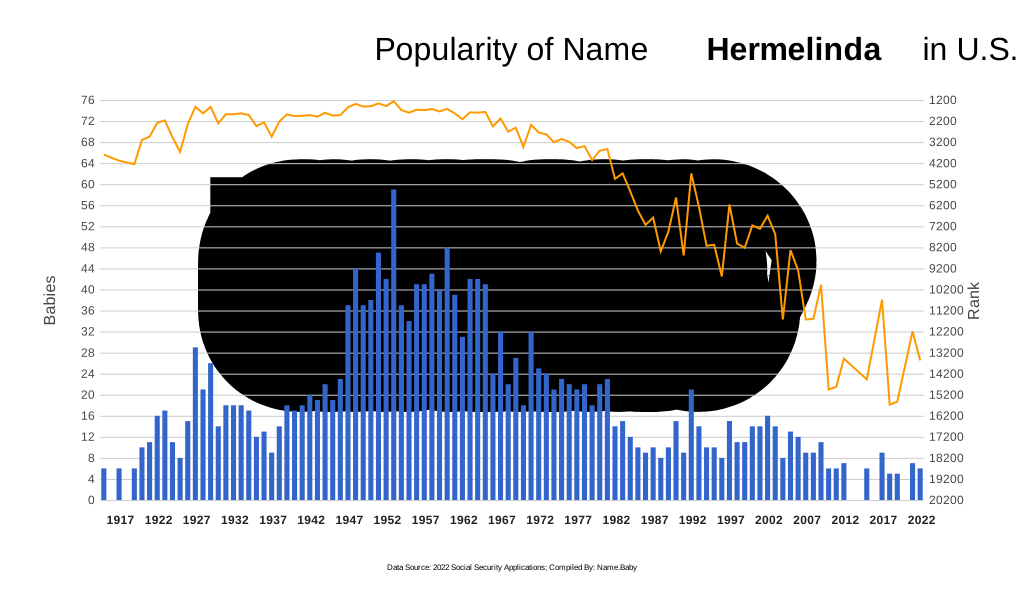
Hermelinda—articulated in Spanish as er-meh-LEEN-dah—traces her lineage to the Visigothic courts where the Germanic elements ermen, “whole” or “universal,” and lind, “soft shield” or “linden tree,” were woven together like gilded threads in a medieval tapestry; as the name migrated south and settled under Iberian skies, it absorbed the warm cadence of Castilian speech and, later, the festive hues of Latin American plazas. Scholars will note that Saint Hermelinda of the Ardennes, a sixth-century anchoress whose quiet piety reportedly coaxed springs from parched earth, lends the name a faint aureole of miracle—an association that, while difficult to verify empirically, does add an enviable footnote to any family’s lore. In everyday symbolism, the “universal shield” implied by the etymology suggests a guardian spirit who stands firm yet gentle, rather like the linden tree that shades summer processions and perfumes the night air with understated confidence. Although contemporary U.S. statistics place Hermelinda languishing in the four-digit ranks—proving that popularity, like fashion, is marvelously fickle—her steady, century-long presence hints at quiet resilience; she is the candle that never quite goes out, even when brighter neon names flicker past. For parents seeking a choice that is at once scholarly and soulful—rich in history, lightly dusted with sainthood, and seasoned with the dry charm of a name that refuses to beg for attention—Hermelinda offers a melodic salutation to the past and a protective whisper for the future.
Pronunciation
Spanish
- Pronunced as er-meh-LEEN-dah (/er.me.ˈlin.da/)
U.S. Popularity Chart
Notable People Named Hermelinda
| Hermelinda Urvina - |
