Inna
Meaning of Inna
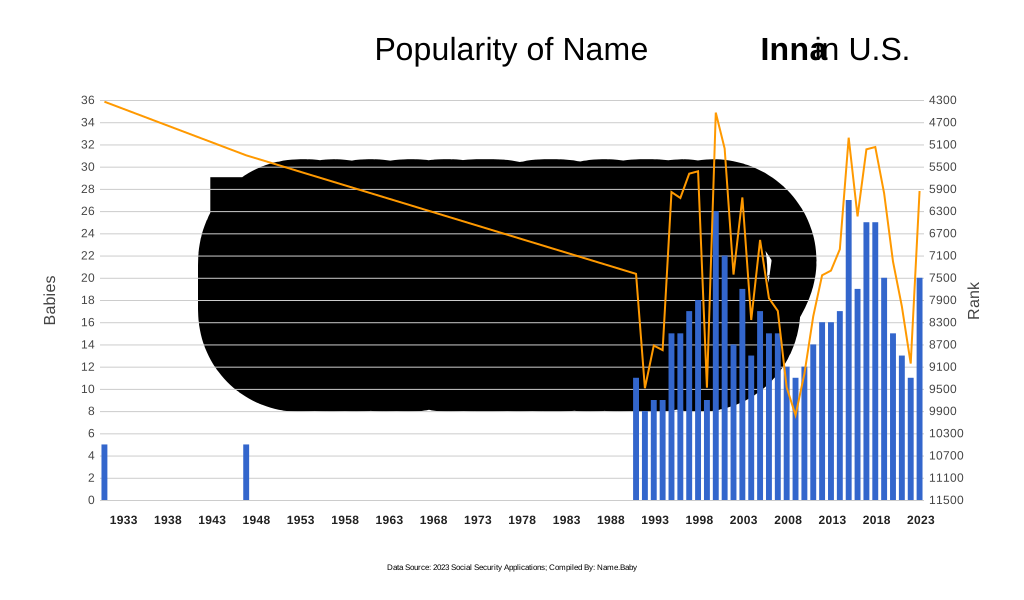
Inna, articulated as /iːnə/ in both Russian and American English, constitutes an Eastern Slavic feminine given name with early attestation in Eastern Orthodox martyrologies, where it is conjecturally derived from a Greek liturgical lexeme or an archaic Germanic compound; over subsequent centuries, it became fully integrated into Russian anthroponymy, semantically connoting resolute clarity and unwavering integrity. Phonologically, the name adheres to a bisyllabic template (CV.CV) featuring a high front vowel /iː/ followed by an alveolar nasal /n/ in the initial closed syllable and concluding with a mid-central schwa /ə/, a configuration that facilitates precise articulation across diverse linguistic contexts. In the United States, Social Security Administration data indicate that Inna has maintained a modest yet consistent presence among female newborns—registering between 11 and 27 occurrences annually and securing rankings between 924 and 951 from 2019 through 2024—thereby reflecting a name whose cross-cultural resonance endures despite limited prevalence.
Pronunciation
Russian
- Pronunced as EE-nah (/iːnə/)
American English
- Pronunced as EE-nuh (/iːnə/)
U.S. Popularity Chart
Notable People Named Inna
| Inna Braverman - |
| Inna Vernikov - |
| Inna Osypenko-Radomska - |
| Inna Stepanova - |
| Inna Eftimova - |
