Izabela
Meaning of Izabela
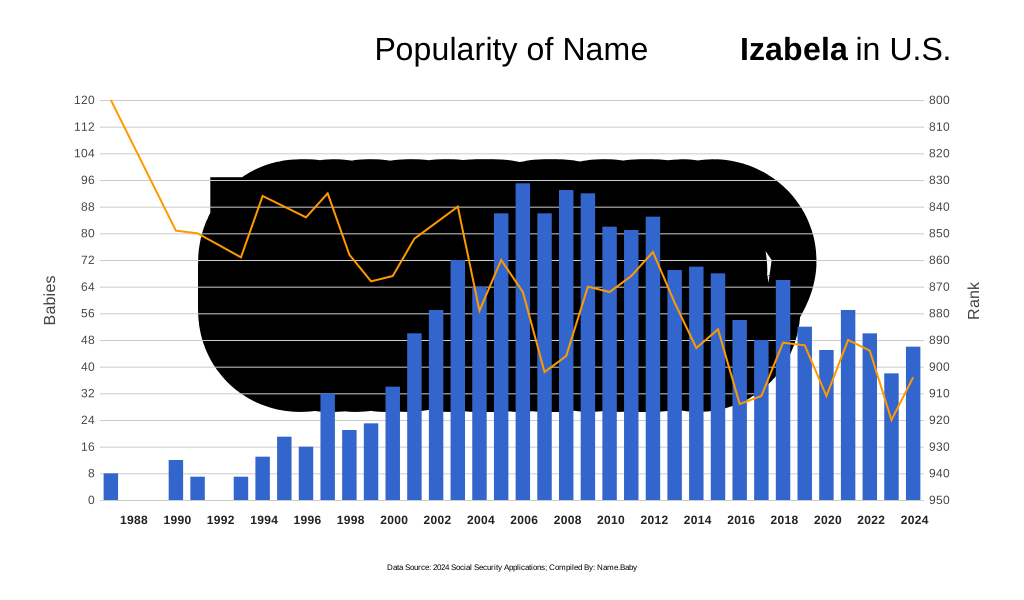
In scholarly examination, the feminine given name Izabela, a morphologically calibrated variant of the Latinized Isabella and ultimately derived from the Hebrew Elisheba (“God is my oath”), emerges as a lexeme redolent of solemnity and lyrical restraint. Its Polish nominative form, transcribed /i.za.ˈbɛ.la/, resonates as a tonal fresco—akin to the chime of ivory bells in a Baroque cathedral—suggesting both devout promise and regal bearing. Across the tumultuous arch of American birth registers, Izabela has traced a sinuous trajectory—fluctuating between rank 800 and 920 over the past four decades—culminating in its contemporary position at 904 with 46 recorded occurrences in 2024, a subtle testament to its enduring yet understated allure. Within its cultural matrix, the name conjures the august courts of medieval Iberia—most notably the resolute spirit of Queen Isabella I of Castile—the austere piety of monastic scriptoria, and the verdant plains of Slavic folklore, thereby weaving a philological tapestry that is at once erudite and warmly evocative. Without the slightest hint of capriciousness—one might even aver that it bears the solemnity of a lab report and the grace of a lyric poem—Izabela stands as an appellation of measured elegance, where each syllable unfolds like a petal of vow-bound devotion.
Pronunciation
Polish
- Pronunced as ee-zah-BEH-lah (/i.za.ˈbɛ.la/)
U.S. Popularity Chart
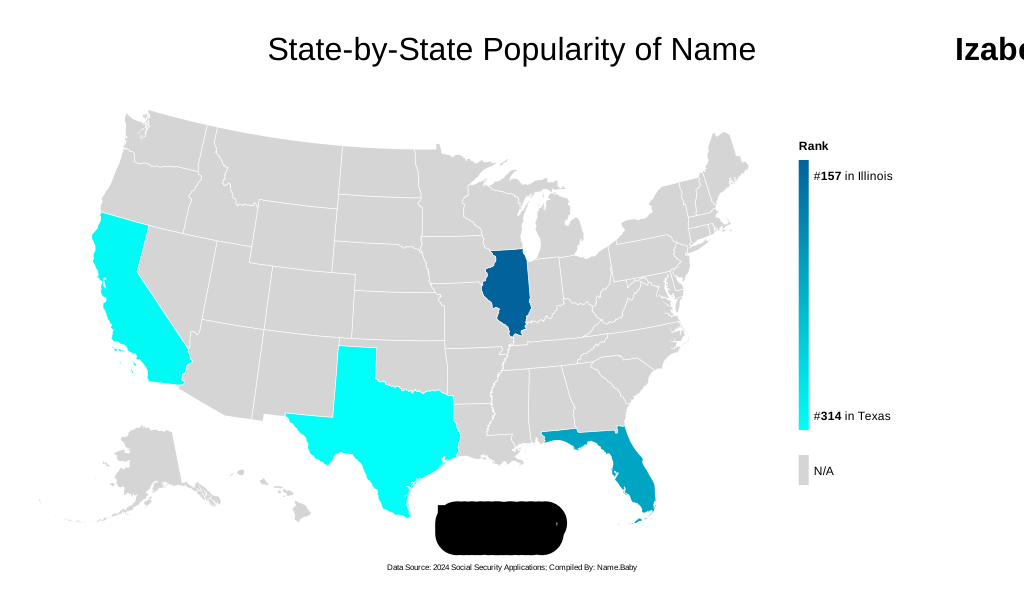
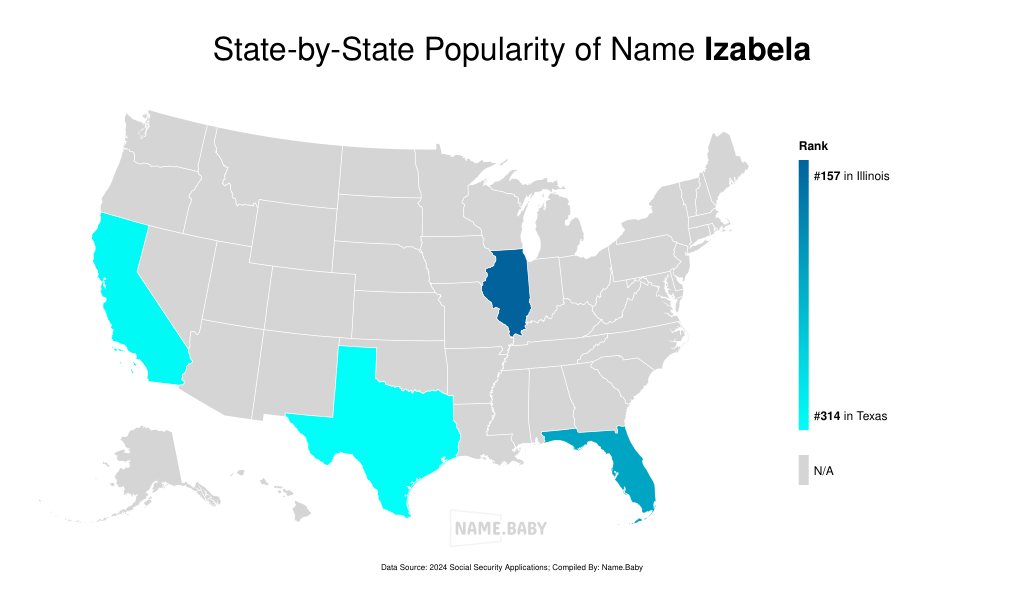
States Popularity Chart
Notable People Named Izabela
| Izabela Sadoveanu-Evan - |
| Izabela Kuna - |
| Izabela Vidovic - |
| Izabela Campos - |
| Izabela Maria Lubomirska - |
