Kendrah
Meaning of Kendrah
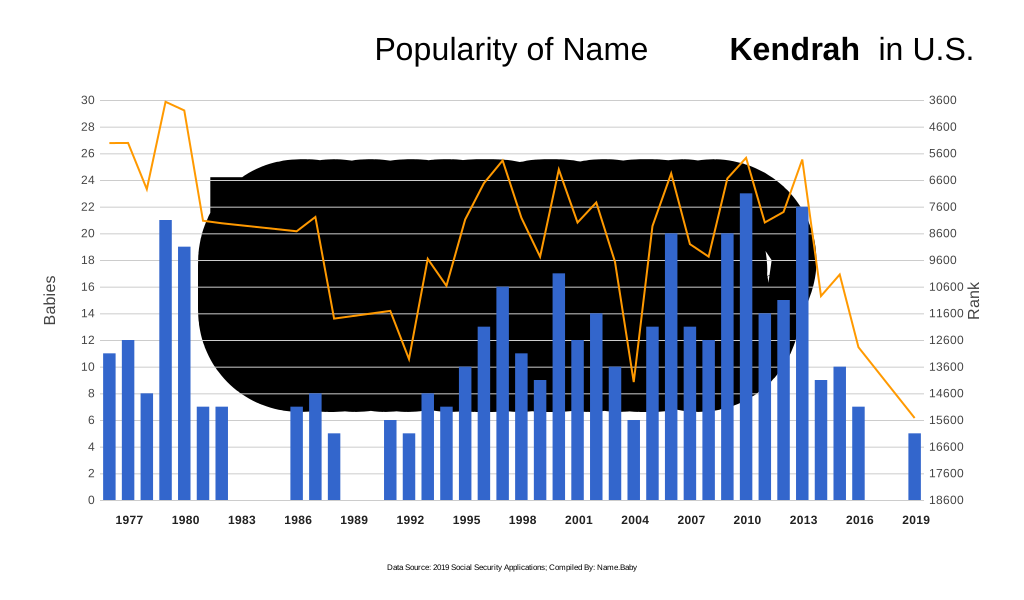
Kendrah, a modern elaboration of the Anglo-American favorite Kendra, traces its etymological roots to the Old English elements cyne, “royal,” and þryð, “strength,” yielding the composite sense of “one who embodies sovereign power.” Philologists additionally note a secondary pathway through the surname Kendrick—derived from the Brythonic Cynwrig, “high chief”—so that Kendrah may also be read as a feminine echo of “wise ruler.” In American vital-statistics records the name surfaces with measurable frequency in 1976, securing a modest rank of 751 and thereafter demonstrating a low-amplitude oscillation that never breaches the mid-700s; its statistical apogee occurs in 1980, followed by a gradual attenuation that places it just inside the lower decile of the Top 1000 through the 1990s. The early twenty-first century brings further contraction—fewer than two dozen registrations annually after 2010—culminating in only five documented births and a rank of 939 in 2019. This sparse yet persistent presence confers on Kendrah an appealing equilibrium: it is sufficiently familiar to avoid orthographic ambiguity while remaining rare enough to preserve an air of distinctiveness. Culturally, the name carries the cool resilience often associated with “Ken-” compounds, evoking both intellectual acuity and understated authority, traits that align well with contemporary Anglo-American ideals of versatile feminine leadership.
Pronunciation
American English
- Pronunced as KEN-druh (/kənˈdrə/)
U.S. Popularity Chart