Mabry
Meaning of Mabry
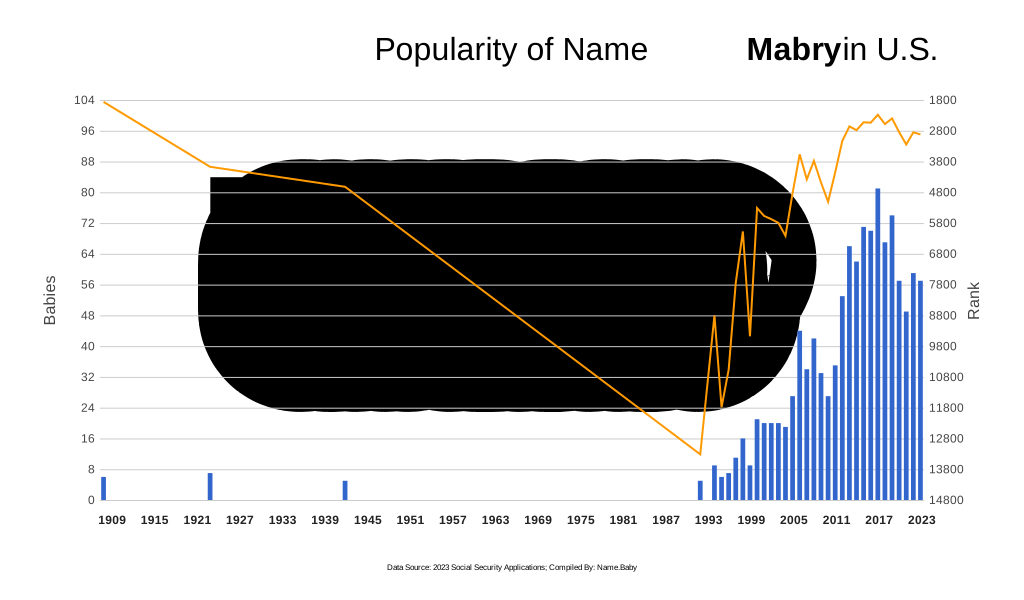
Mabry, pronounced MAY-bree (/meɪˈbri/), originated as an Anglo-Norman surname whose historical spellings—Maubrey, Maybury, and Mayberry among them—trace to two intertwined sources: first, the Germanic personal name Alberic (Aubrey) carried to England by the Normans, and second, English locative terms meaning “meadow fort” that gradually converged in pronunciation; through these channels the name entered colonial America, where Huguenot and Scots-Irish families implanted it most visibly in the South. As a forename for girls it has never broken into the mainstream, yet United States records show a quiet persistence: an isolated appearance in 1908, dormancy until the 1920s and 1940s, and then a continuous though modest presence since the late 1990s, typically hovering in the 850–950 range. The sound profile—combining the familiarity of “May” with the lilting “-bree” ending—confers both clarity and subtlety, positioning Mabry as a restrained alternative to phonetic cousins such as Avery or Emery. Cultural associations reinforce this dual character: genealogists invoke frontier land deeds and Huguenot church rolls, while popular memory detects a faint echo of the fictional Mayberry, symbol of small-town decorum. Consequently, Mabry offers contemporary parents a name that is historically grounded, phonetically concise, and quietly emblematic of the long Anglo-American practice of turning surnames into given names.
Pronunciation
American English
- Pronunced as MAY-bree (/meɪˈbri/)
U.S. Popularity Chart
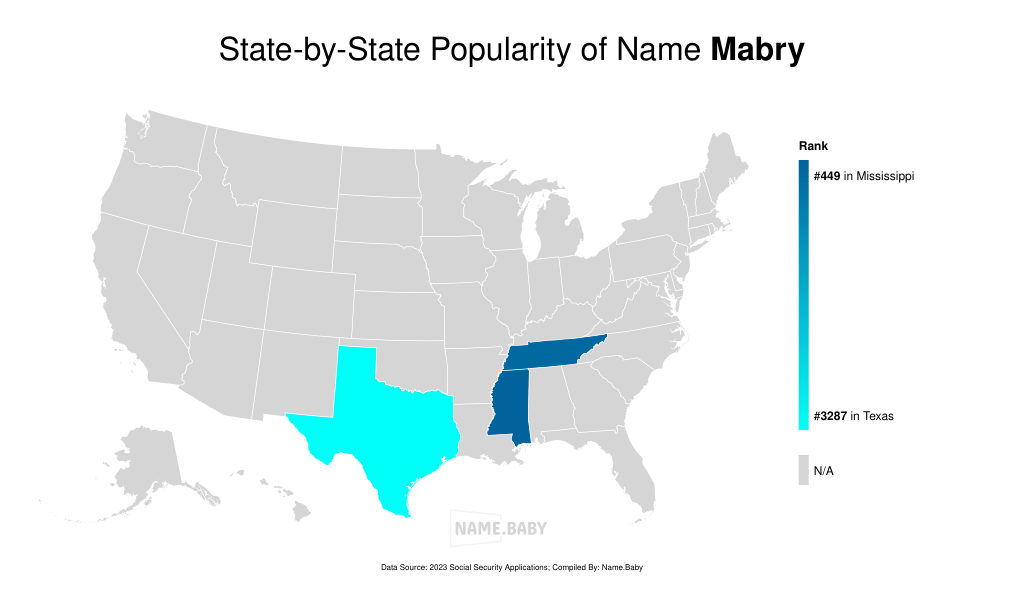
States Popularity Chart
Notable People Named Mabry
| Mabry A. Carlton - |
