Prentice
Meaning of Prentice
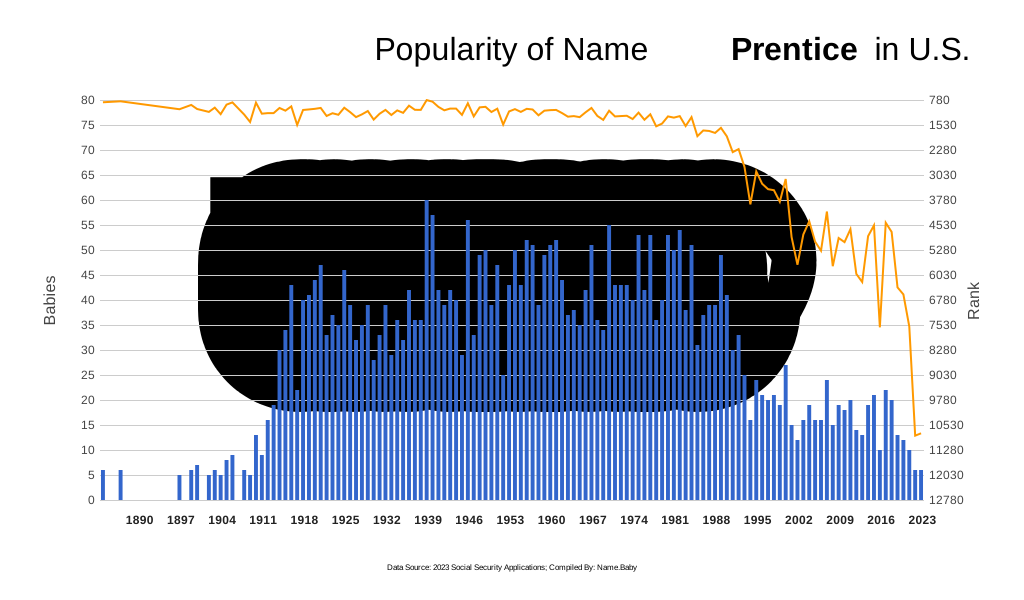
Prentice is a masculine English-language given name of Anglo-American provenance, etymologically derived from the Middle English prentise—borrowed from Old French aprentiz and ultimately from Latin apprehendere, “to seize” or “to undertake”—originally denoting an individual bound by contract to a master craftsman in the structured vocational system of medieval Europe. Over subsequent centuries it transitioned from occupational byname to hereditary surname and, more recently, to distinctive forename, its semantic core of apprenticeship and disciplined learning retaining symbolic resonance. In the United States, Prentice has sustained a modest yet remarkably consistent presence in the Social Security data since the late nineteenth century, with annual occurrences rarely exceeding the low double digits and most recently registering six newborns in 2024 for a national rank of 918; during the past four decades its popularity has oscillated predominantly between the 600th and 900th positions, underscoring both its rarity and its enduring appeal among parents seeking a name that conveys historical depth, artisanal heritage, and intellectual rigor. Pronounced PREN-tis (/ˈprɛn.tɪs/) in contemporary American and British English, the name offers phonetic clarity and a compact structure that harmonize with its technical etymology and cultural associations.
Pronunciation
English
- Pronunced as PREN-tis (/ˈprɛn.tɪs/)
U.S. Popularity Chart
Notable People Named Prentice
| William Prentice Cooper Jr. was a Tennessee governor who led the state's World War II mobilization and later served as ambassador to Peru. |
| Prentice Earl Sanders became the first African American chief of the San Francisco Police Department in 2002. |
| Prentice Penny is an American writer, producer and director best known as the showrunner of Insecure and the writer and director of Uncorked. |
| Prentice Mulford was an American humorist and author who helped shape the New Thought movement and its Law of Attraction principles. |
| Prentice Gautt was a running back who became the first Black football player at the University of Oklahoma, playing from 1956 to 1959. |
