Renardo
Meaning of Renardo
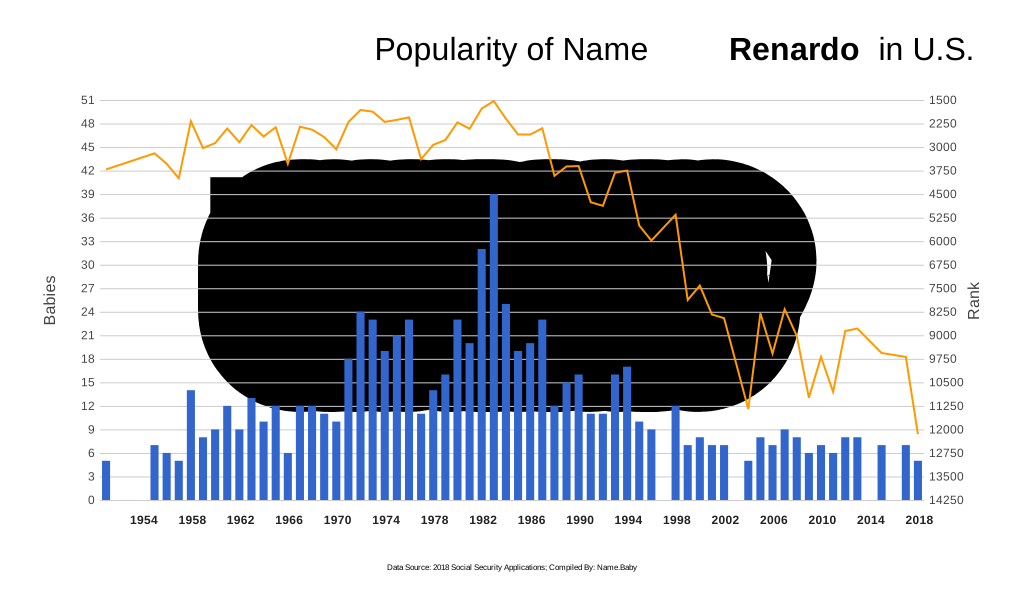
Renardo emerges as a unisex appellation with etymological roots in the Old High German elements ragin (“counsel”) and hard (“brave, hardy”), refracted through the Old French form Renard—whose literary and heraldic associations with the fox impart a layer of symbolic cunning—and later assimilated into Spanish and Italian onomastic traditions. Analytical examination of U.S. birth‐registration data since the early 1950s indicates a consistently low but persistent level of adoption, punctuated by occasional frequency peaks—most notably in the early 1980s—and a modest resurgence in the 2010s, yielding annual occurrences typically between five and twelve and corresponding Social Security ranks in the 800–900 range. Phonetically rendered in English as ruh-NAR-doh (/rəˈnɑːdəʊ; -rdoʊ/), the name’s paroxytone stress pattern and open‐vowel termination confer a measured sonority that facilitates cross-cultural intelligibility without sacrificing distinctiveness. Its sustained yet rarefied presence within an Anglo-American context, combined with its gender‐neutral application, underscores Renardo’s appeal as a technically coherent choice for parents prioritizing both semantic depth and phonological precision.
Pronunciation
British English
- Pronunced as ruh-NAR-doh (/rəˈnɑːdəʊ/)
American English
- Pronunced as ruh-NAR-doh (/rəˈnɑrdoʊ/)
U.S. Popularity Chart
Notable People Named Renardo
| Renardo Sidney - |
