Rondi
Meaning of Rondi
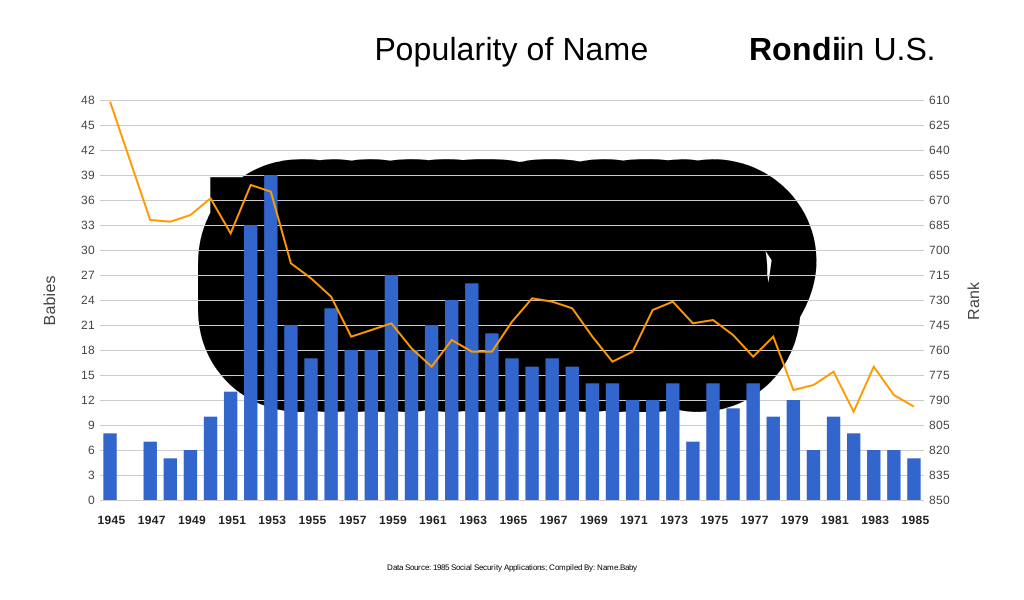
Rondi, a name of intricate onomastic lineage, interlaces the martial legacy of the Old Norse randr—literally “rim of a shield”—with the intimate warmth of the Italian diminutive suffix -i, yielding a designation at once protectively robust and endearingly soft. Phonologically rendered as RAHN-dee (/ˈrɑn.di/ or /ˈrɒn.di/), its two syllables unfurl like the measured phrases of a Baroque rondò, recurrent yet ever-renewing, evoking the Latin rota, “wheel,” and the cyclical rhythms of life and mythology. Through its association with the Italian rondò, this appellation conjures sunlit Florentine courtyards and pealing sonatas, while its Teutonic origin speaks to an ancestral ethos of guardianship and resilience. Although Rondi’s appearance in U.S. birth registers from the late 1940s through the mid-1980s was modest—peaking quietly in the early 1950s before receding into gracious obscurity—its rarity today bestows a clandestine elegance, as though each pronunciation were a carefully inscribed verse in a silent Roman codex. In academic circles of name-study, Rondi is lauded for its elegant synthesis of diverse linguistic traditions, carrying its scholarly gravitas with a warmth reminiscent of a Mediterranean hearth. Rarely mobilized by nursery rhymes or cartoon banter, it nonetheless radiates quiet authority—an appellation that, with wry reserve, might be described as a monograph masquerading as a lullaby.
Pronunciation
American English
- Pronunced as RAHN-dee (/ˈrɑn.di/)
British English
- Pronunced as RAHN-dee (/ˈrɒn.di/)
U.S. Popularity Chart
Notable People Named Rondi
| Rondi Reed - |
