Safwan
Meaning of Safwan
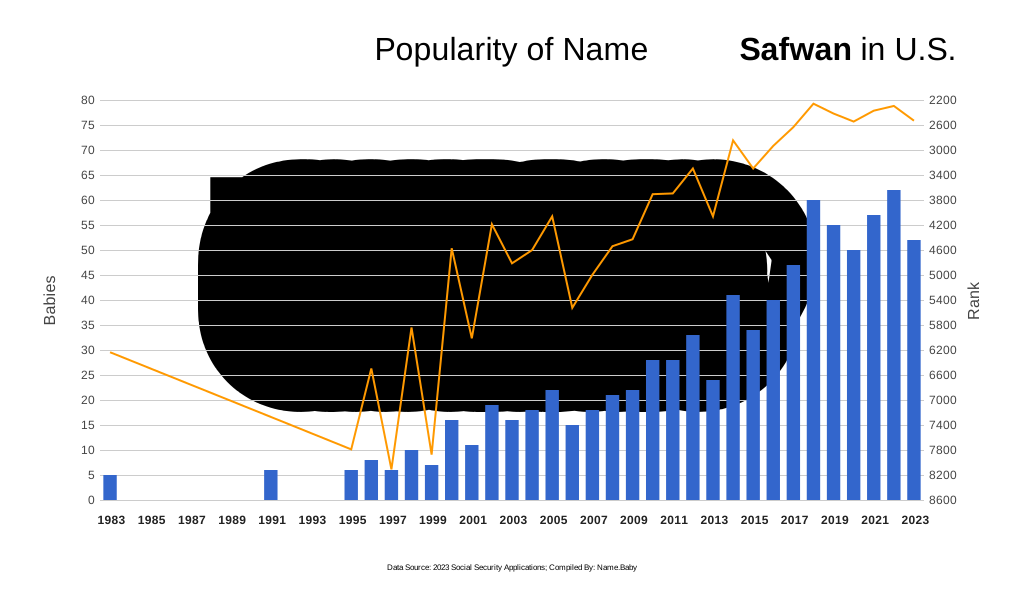
Safwan, a masculine given name of Arabic provenance, derives from the triliteral root Ṣ-F-W and denotes a “smooth, polished stone,” an image that in classical usage extends metaphorically to ideas of clarity, purity, and steadfastness; the term appears in Qur’anic discourse (e.g., 2:264), and its historical stature is reinforced by early Islamic figures such as Safwan ibn Muʿattal and Safwan ibn Umayya, both of whom are cited in seventh-century sources. Pronounced SAHF-wahn (/ˈsæf.wæn/) in English as well as Arabic, the name transitions readily between languages because it contains no phonemes alien to the Anglo-American sound system, a characteristic that may explain its quiet yet durable presence in the United States: since first surfacing on the Social Security Administration’s charts in 1983, annual registrations have fluctuated between roughly five and sixty births, consistently anchoring the name in the upper-800s of the national ranking. This statistical pattern suggests a niche but enduring appeal among parents who favor culturally distinctive appellations imbued with theological resonance and transparent semantics. For Muslim families, Safwan naturally evokes its Qur’anic and historical legacy; for a broader audience, its semantic field—connoting lucidity and resilience—aligns with contemporary naming trends that value virtue-laden etymology. The result is a cross-cultural given name that balances historical gravitas with modern phonetic accessibility.
Pronunciation
Arabic
- Pronunced as SAHF-wahn (/ˈsæf.wæn/)
U.S. Popularity Chart
Similar Names to Safwan
Notable People Named Safwan
| Safwan M. Masri - |
| Safwan Abdul-Ghani - |
| Ṣafwān ibn Idrīs - |
