Selenne
Meaning of Selenne
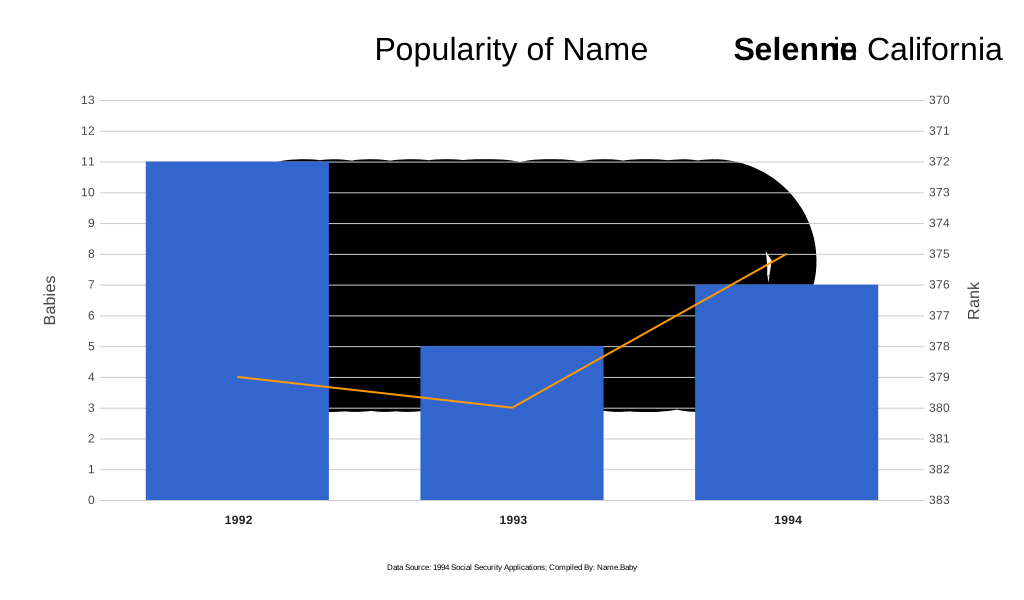
Selenne, a mellifluous variant of the classical Selene, traces its etymological roots to the Greek σελήνη—“moon”—yet, through the soft alchemy of Spanish phonology, acquires a gently rolling cadence that feels at once scholarly and serenata-ready. Beneath its luminous surface lies a tapestry of associations: the radiant lunar goddess who steered her silver chariot across archaic skies, the scientific realm of selenology that still coaxes astronomers to lose sleep in polite homage, and, in modern California, a brief but telling shimmer on birth ledgers—rising to 11 newborn bearers in 1992 before retreating to a demure 5 in 1993, a pattern as cyclical as any tide she is said to command. Pronounced seh-LEH-ne in Spanish and streamlined to seh-LEN in English, the name moves effortlessly between languages, much like moonlight slipping between clouds, conferring on its bearer the quiet authority of a nocturnal luminary. One could argue, with suitably dry assurance, that gifting Selenne is less an act of naming and more a gentle enrollment into an ancient, moon-lit fellowship—where myth, science, and a dash of California census data converse over midnight coffee.
Pronunciation
Spanish
- Pronunced as seh-LEH-ne (/seˈle.ne/)
English
- Pronunced as seh-LEN (/sɛˈlɛn/)
U.S. Popularity Chart
Notable People Named Selenne
| Selenne Bañuelos - |
