Takeo
Meaning of Takeo
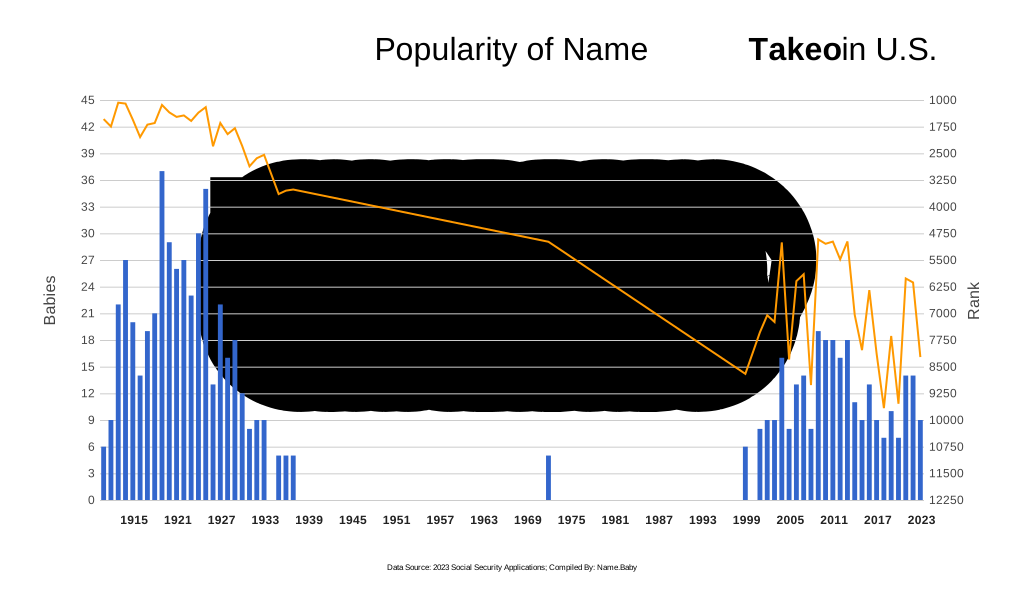
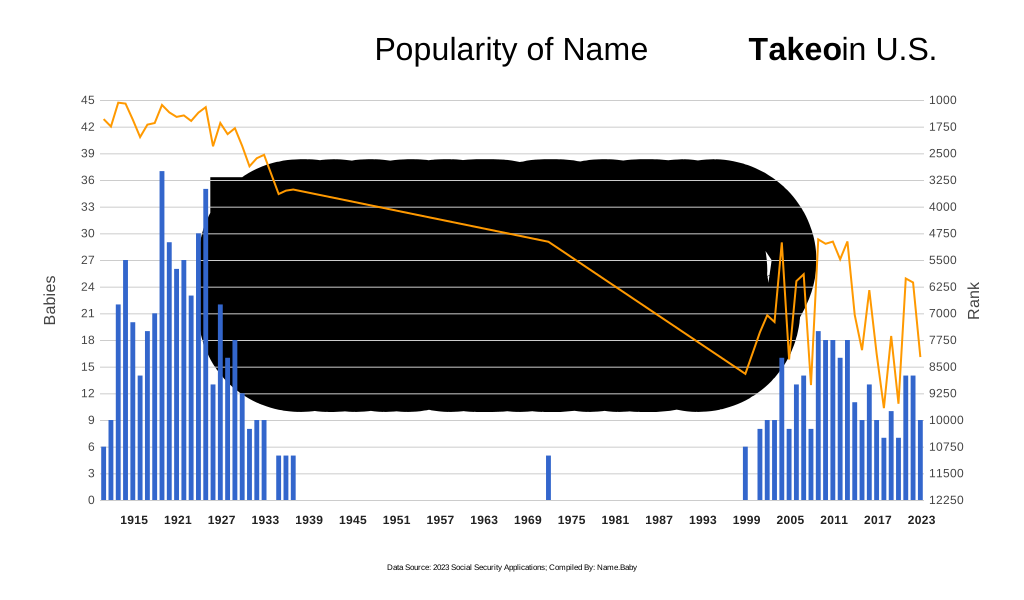
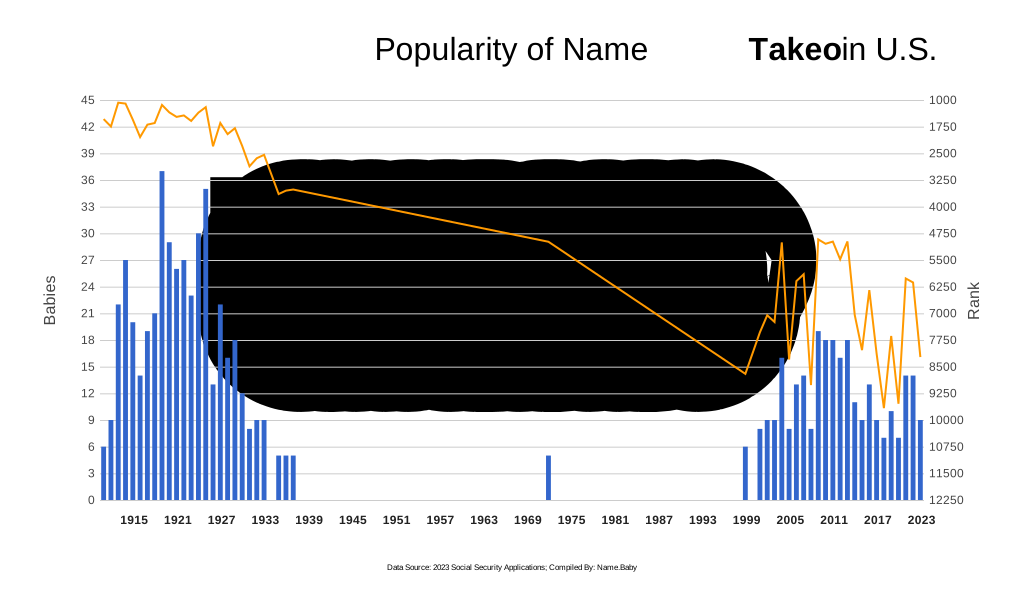
Takeo is a masculine Japanese given name derived from the kanji for “martial” (武) and “man” (雄), historically borne by samurai and feudal leaders to convey strength and authority. Pronounced in English as /taˈkeɪ.oʊ/, its three-syllable structure offers both clarity and balance. In the United States, Takeo remains rare—annual occurrences have ranged from seven to fifteen births over the past five years, with Social Security rankings consistently in the low 900s—reflecting its niche adoption among parents seeking distinctive yet linguistically accessible names. Although its usage outside Japan is modest, Takeo’s precise phonetic profile and rich historical associations make it an analytically compelling choice for families valuing cultural depth and technical coherence.
Pronunciation
Japanese
- Pronunced as tah-keh-oh (/taˈkeɪ.oʊ/)
U.S. Popularity Chart
Notable People Named Takeo
| Takeo Kurita was a Japanese vice admiral who led the main Japanese attack force at the Battle of Leyte Gulf during World War II. |
| Takeo Yoshikawa was a Japanese spy in Hawaii before the 1941 attack on Pearl Harbor. |
| Takeo Kanade is a Japanese computer scientist and Carnegie Mellon professor known for his pioneering work in computer vision. |
| Takeo Takahashi is a former Japanese football player and manager who played for Japan's national team. |
| Takeo Kawamura is a former Japanese politician who served as Chief Cabinet Secretary from 2008 to 2009. |
| Takeo Wada was a Japanese mathematician known for inspiring the Lakes of Wada, a concept in topology. |
| Takeo Moriyama is a Japanese jazz drummer. |
| Takeo Ando, also known as Takeo Suzuki, is a professional Go player. |
| Takeo Kimura is a Japanese weightlifter who competed in the men's lightweight event at the 1968 Summer Olympics. |
