Tashvi
Meaning of Tashvi
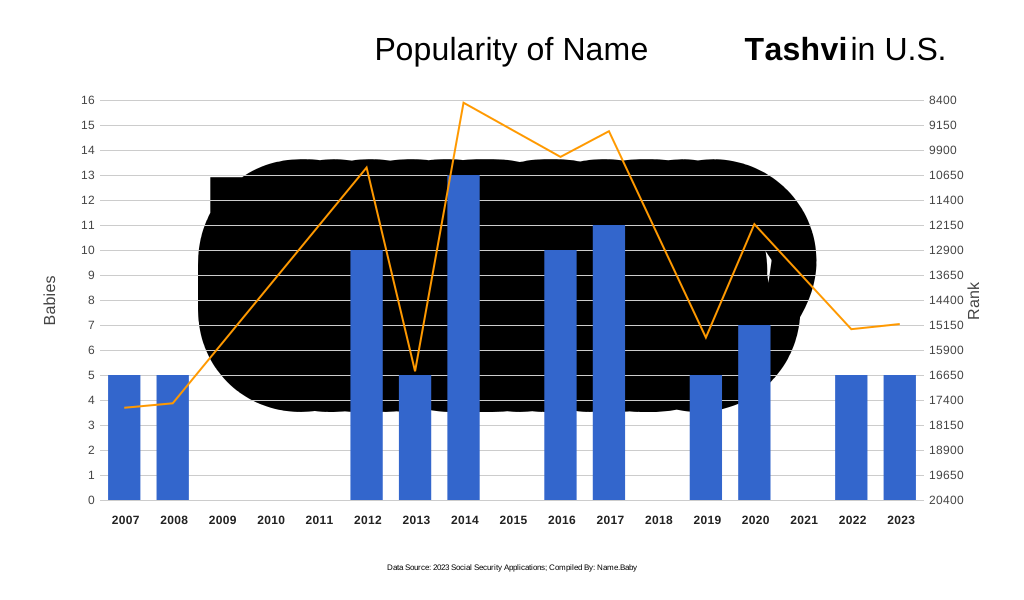
Tashvi, pronounced TASH-vee, arises from Sanskrit roots that juxtapose taś (auspice) and vi (to shine), yielding the interpretive gloss “radiant with good fortune”—a meaning that resonates with the Roman ideal of felicitas and lends the name a cross-cultural echo. Although its statistical footprint in the United States remains modest—never exceeding thirteen occurrences in a single year and oscillating between the 930th and 990th ranks from 2008 to 2023—the steady trickle of registrations suggests a subtle diffusion typical of diasporic nomenclature, in which linguistic heritage quietly negotiates space within new social registers. Phonetically crisp, the trochaic stress pattern (TASH-vee) allows the name to glide through both Indo-Aryan and English phonological systems without significant adaptation, a feature that may account for its incremental adoption among multilingual families. Symbolically, Tashvi can be read as a kind of lumen parvum, a small light, one that promises prosperity without ostentation; in that restrained glow, parents often perceive the virtue prized in both classical Sanskrit and Latin maxims—serenitas in action, auspicious yet measured.
Pronunciation
- Pronunced as TASH-vee (/tæʃ-vi/)
U.S. Popularity Chart