Young
Meaning of Young
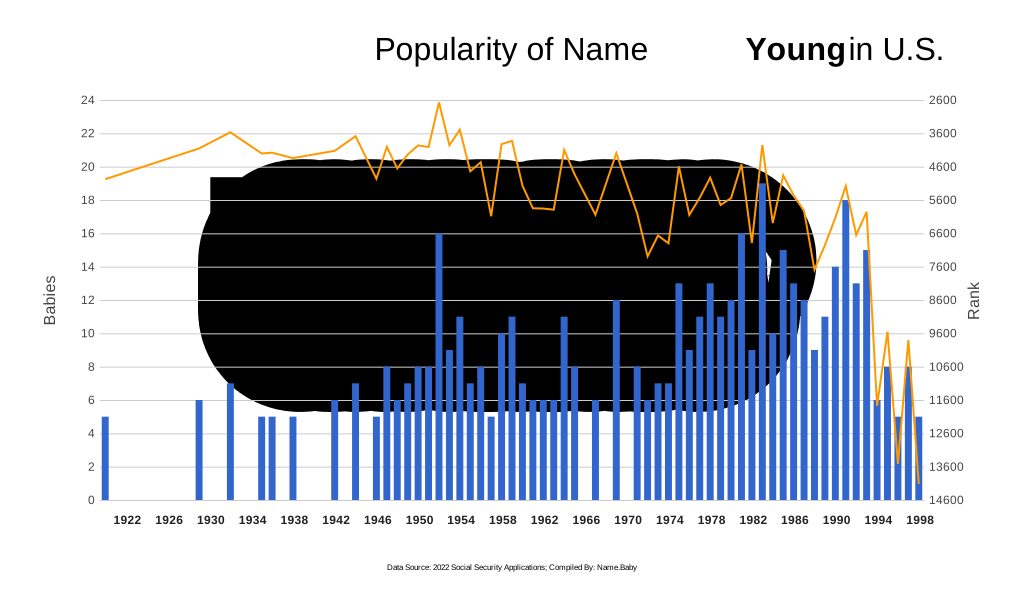
The appellation Young, enunciated yuhng (/jʊŋ/), derives etymologically from the Old English geong ‘youthful’ (Proto-Germanic *jungaz) while also serving as a romanization of Korean and Chinese surnames, thus weaving a bicultural nomen that resonates with both Anglo-Saxon vigor and East Asian lineage; this convergence of traditions has yielded a unisex choice whose American usage, though modest—five to nineteen annual occurrences from the 1920s through the 1990s with Social Security rankings habitually clustered between 590 and 875—demonstrates that brevity need not forfeit substance. Much like a Latin praenomen that simultaneously identifies the individual and invokes the gens, Young conveys a promise of renewal and resilience, its single syllable reverberating with the latent energy of spring shoots breaking through winter’s frost; even the driest purveyor of statistics must admit that, despite its temporal implication, few parents are naïvely consigning their child to perpetual adolescence, but rather embracing a moniker that marries the ephemeral bloom of youth with the enduring strength of ancestral roots. In its expository elegance, Young stands as a testament to how one solitary name can compose a contrapuntal motif of vitality and tradition, offering bearers a succinct yet sonorous identity that transcends cultural boundaries.
Pronunciation
English
- Pronunced as yuhng (/jʊŋ/)
U.S. Popularity Chart
Notable People Named Young
| Young Dolph - |
| Young M.A - |
| Young MC - |
| Young Thug - |
