Ama
Meaning of Ama
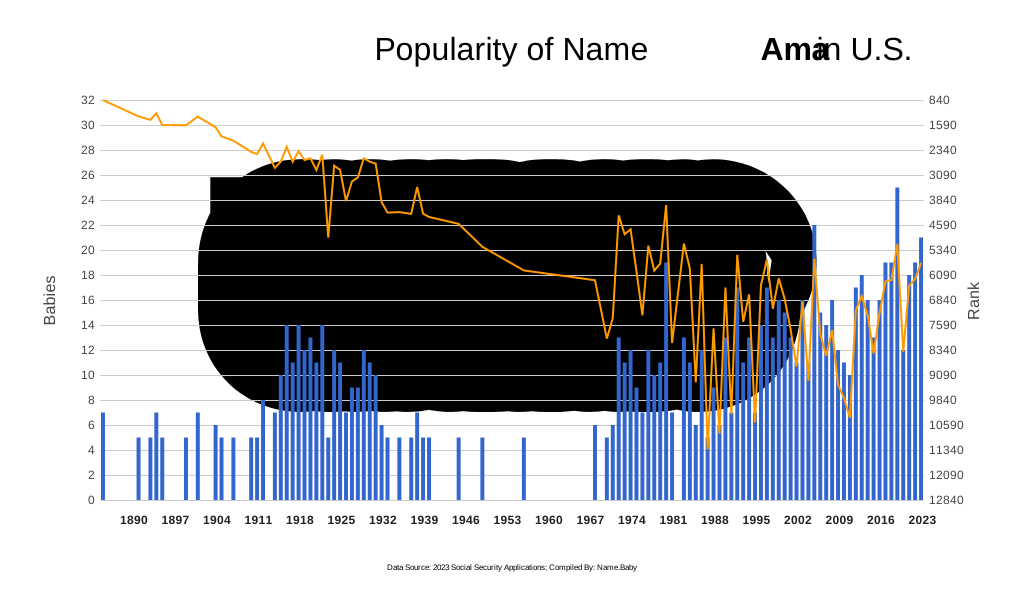
Ama is a feminine given name of Akan provenance, signifying “born on Saturday” within the structured day-naming system of the Akan peoples of Ghana and the Ivory Coast, and it has achieved phonological integration into Anglo-American contexts through two principal English pronunciations—/ˈɑmɑ/ and /ˈeɪmɑ/. Its concise CV–CV morphology, comprising a low central vowel and a bilabial nasal, conforms to widely attested phonotactic preferences and facilitates ease of articulation across diverse linguistic backgrounds. As a component of Akan cultural continuity, Ama conveys both calendrical specificity and social symmetry, while in the United States it has maintained a stable, modest profile—ranking between 925 and 944 from 2020 to 2024 with annual occurrences of 12 to 21—according to Social Security Administration data. The continued, if niche, adoption of Ama underscores a broader naming trend that privileges succinctness, semantic resonance, and the acknowledgment of multicultural heritage.
Pronunciation
Variation 1
- Pronunced as AH-mah (/ˈɑmɑ/)
Variation 2
- Pronunced as AY-mah (/ˈeɪmɑ/)
U.S. Popularity Chart
Notable People Named Ama
| Ama Ata Aidoo - |
| Ama Agbeze - |
| Ama K. Abebrese - |
| Ama Benyiwa-Doe - |
| Ama Samy - |
| Ama Hemmah - |
| Ama Governor - |
| Ama Qamata - |
| Ama Ampofo - |
| Ama Pipi - |
| Ama Duncan - |
| Ama Bame Busia - |
| Ama Codjoe - |
| Ama Afo Blay - |
| Ama Sodogah - |
