Arthur
Meaning of Arthur
Arthur is a name of Celtic origin, though its exact derivation is uncertain. The explanation most dictionaries give is that it comes from the Welsh word arth, meaning bear, perhaps joined to a word for man, giving a sense such as bear-man; others point instead to the Roman family name Artorius. It is pronounced AHR-thur in both British and American English.
Its best-known association is legendary rather than historical: King Arthur, the British leader of medieval romance, around whom the Round Table and the Grail quests gathered. Among real bearers, Sir Arthur Conan Doyle, creator of Sherlock Holmes, and the tennis champion Arthur Ashe are the most widely recognized.
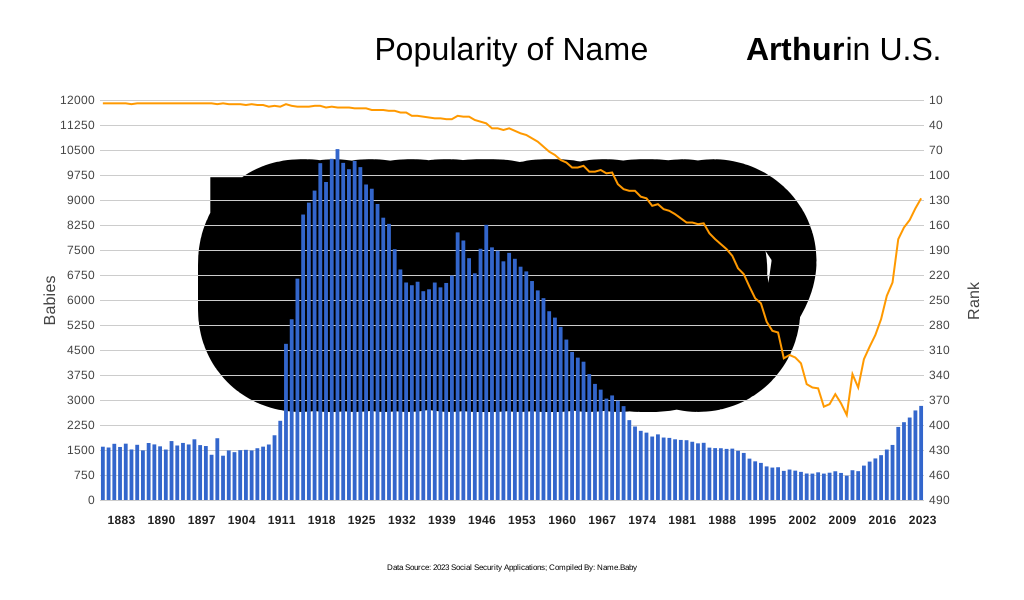
In the United States the name has long been common. It ranked 14th in 1880 and was still 14th in 1899, then declined steadily through the twentieth century, falling to 388th in 2010, when 730 boys received it. It has climbed sharply since: 3,847 boys were named Arthur in 2025, when it ranked 87th, its best position since 1961.
Pronunciation
British English
- Pronunced as AHR-thur (/ˈɑːθər/)
American English
- Pronunced as AHR-thur (/ˈɑr.θər/)
U.S. Popularity Chart
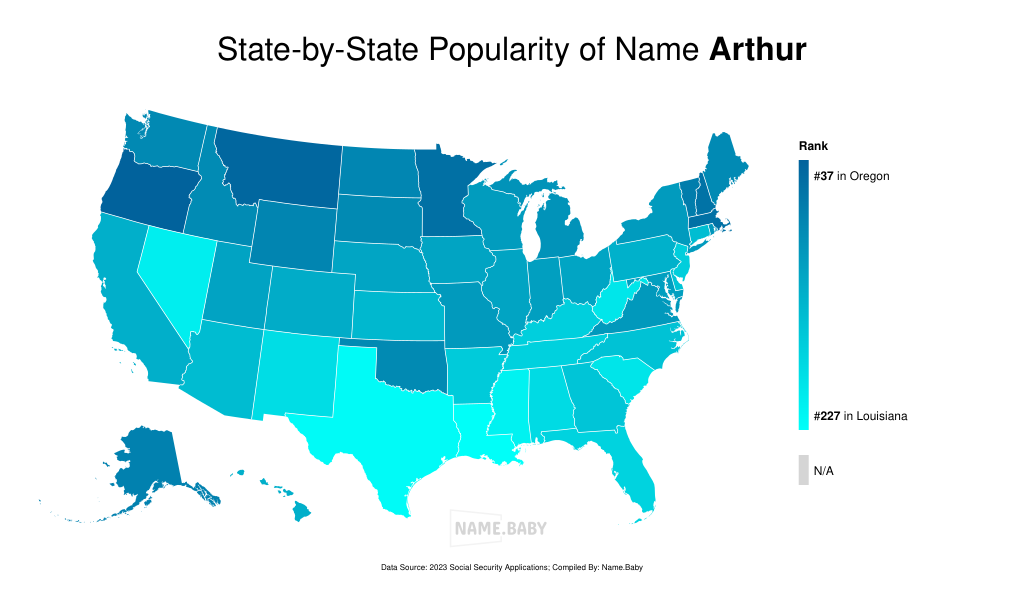
States Popularity Chart
Notable People Named Arthur
| Arthur Schopenhauer was a German philosopher whose 1818 work The World as Will and Representation cast reality as blind will and advanced an atheistic break from German idealism. |
| Sir Arthur Conan Doyle was a British writer and physician who created Sherlock Holmes in 1887 and wrote four novels and 56 stories that became landmarks of crime fiction. |
| Arthur Morton Godfrey was a major American radio and television entertainer who in the early to mid 1950s hosted multiple CBS shows like Arthur Godfrey Time and Talent Scouts, broadcasting as often as six days a week. |
| Arthur Rimbaud was a French poet whose radical, dreamlike verse transformed modern literature and anticipated surrealism. |
| Arthur Ashe was an American tennis champion who won three Grand Slam singles titles, became the first Black US Davis Cup player, and is the only Black man to win singles at Wimbledon, the US Open, and the Australian Open. |
| Arthur William Currie rose from militia gunner to lead the Canadian Corps in World War I, innovating trench tactics and earning a reputation as one of Canada’s greatest commanders. |
| Arthur Rubinstein was a Polish American pianist widely hailed as one of the greatest, celebrated for his Chopin interpretations and a public career spanning eight decades. |
| Arthur M. Schlesinger Jr. - Arthur Schlesinger Jr. was an American historian of 20th century liberalism who advised Adlai Stevenson, served President John F. Kennedy, and won a Pulitzer Prize for A Thousand Days. |
| Arthur Rackham was a leading English book illustrator of the Golden Age, known for robust pen and ink drawings blended with watercolor shaped by his journalistic background. |
| Arthur Frank Burns was an American economist and diplomat who chaired the Federal Reserve from 1970 to 1978, previously chaired the Council of Economic Advisers under President Eisenhower, served as Counselor to President Nixon in 1969, and taught at Rutgers, Columbia, and the National Bureau of Economic Research. |
| Sir Arthur Henry Rostron was the British Cunard captain of RMS Carpathia who led the 1912 rescue of Titanic survivors. |
| Sir Arthur Helps was an English writer and dean of the Privy Council, a Cambridge Apostle, and an early advocate of animal rights. |
| Arthur Kornberg was an American biochemist who shared the 1959 Nobel Prize for uncovering how cells synthesize RNA and DNA and later received major honors including the National Medal of Science. |
| Arthur Wharton was a British footballer widely regarded as the first black professional and the first to play in the Football League, though earlier black amateurs predated him. |
